
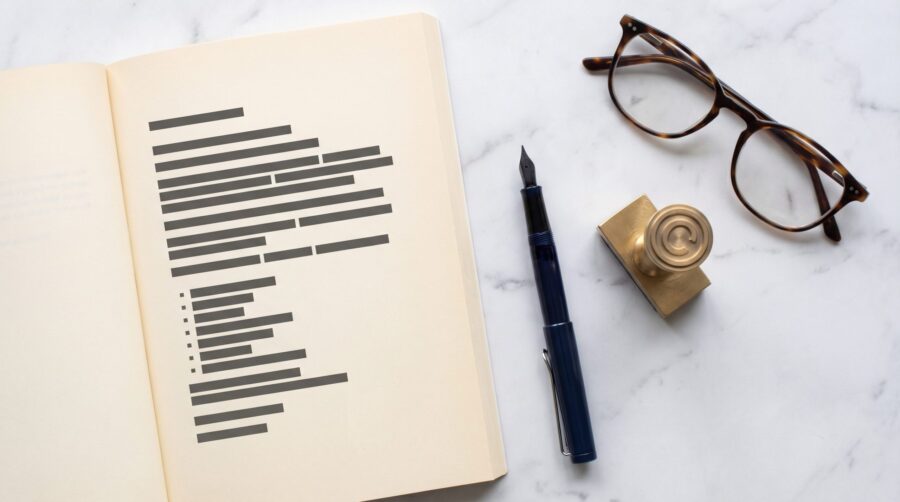
The copyright page of a self-published book needs, at minimum, a copyright notice: the © symbol (or the word “Copyright”), the year of first publication, and the name of the copyright holder. Everything else on the page is conventional rather than legally required. Many self-published authors also include an “all rights reserved” statement, an ISBN, a brief disclaimer, and the name of their publishing imprint, but none of these elements are mandated by law.
- What Is Legally Required on a Copyright Page?
- What Are the Standard Elements of a Copyright Page?
- Which Elements Are Required, and Which Are Convention?
- Which Disclaimer Does Your Book Need?
- What Does a Complete Copyright Page Look Like?
- How Does a Copyright Page Differ Between Print and Ebook?
- What Should Change on the Copyright Page for a New Edition?
- Frequently Asked Questions
What Is Legally Required on a Copyright Page?
Nothing. Under 17 US Code § 401, a copyright notice is not required for works first published on or after March 1, 1989, when the United States joined the Berne Convention. Copyright protection is automatic the moment you fix an original work in a tangible form. You do not need to register, file, or print any notice to own the copyright to your book. The same principle holds across the 182 contracting parties to Berne, so an author outside the US is in the same position: protection arises on creation, without formalities.
That said, including a proper copyright notice is still worth doing, and the reason is specific rather than general. Section 401(d) provides that where a notice in the correct form and position appears on a copy the defendant had access to, “no weight shall be given” to an innocent infringement defense in mitigation of damages. In plain terms, a notice removes the argument that the infringer did not know the work was protected. For a self-published author without a legal team, that is worth the single line of text.
The notice itself has three components, which the US Copyright Office’s Circular 3 describes as generally appearing “as a single continuous statement”: the symbol © (or the word “Copyright” or the abbreviation “Copr.”), the year of first publication, and the name of the copyright owner. For example: © 2026 Jane Author.
Position is a separate question, and this is where a common piece of internet advice overstates the rule. Section 401(c) requires only that a notice be “affixed to the copies in such manner and location as to give reasonable notice of the claim of copyright,” and directs the Register of Copyrights to publish examples that satisfy it. Those examples are the Copyright Office’s placement regulations, now at 37 CFR § 202.2(c), and for works published in book form paragraph (c)(4) lists eight acceptable positions: the title page itself, the page immediately following the title page, either side of the front cover, either side of the back cover, the first page of the main body, the last page of the main body, and two page ranges near the front and back. (Older articles cite 37 CFR § 201.20 for this; that section was removed in 2017 and its contents relocated to § 202.2.) The verso of the title page is one acceptable position among several, not a legal requirement. It is where the page goes because trade publishing has put it there for a century and readers, librarians, and retailers look for it there.
What Are the Standard Elements of a Copyright Page?
While only the copyright notice carries legal weight, trade publishing convention has established a set of elements that readers, librarians, and retailers expect to see. Two faults account for most of the copyright pages that reach us with a manuscript: a page padded with borrowed legalese from a traditionally published book, including a printer’s key and a distributor’s address that mean nothing for a print-on-demand title, or a page carrying nothing but a bare year and a name. Here is what belongs on it and what each element actually does.
Copyright notice. The © symbol, year, and owner name, as described above. If you have registered your copyright with the US Copyright Office, you can add “Registered with the US Copyright Office” beneath the notice, but registration is not required for protection.
“All rights reserved” statement. This phrase originated from the Buenos Aires Convention of 1910, which required a rights-reservation statement for copyright protection across signatory countries. That requirement became fully obsolete on August 23, 2000, the date Nicaragua’s accession to the Berne Convention entered into force, according to WIPO’s record of contracting parties. Nicaragua was the last Buenos Aires signatory still outside Berne, and Berne grants protection without formalities. The phrase has no confirmed legal force in any jurisdiction today. It persists by convention, and there is no cost to including it; just know it is ceremonial rather than protective.
ISBN. If your book has an International Standard Book Number, list it on the copyright page. Each format needs its own ISBN: one for paperback, one for hardcover, one for ebook. If you publish in multiple formats, you can list all ISBNs on the copyright page with the format noted in parentheses after each one. One important caveat: if you use platform-supplied ISBNs from more than one distributor (for example, a free KDP ISBN and a free IngramSpark ISBN), include only that platform’s ISBN in the files you upload to it. For guidance on when you need separate ISBNs, see our post on whether KDP and IngramSpark require separate ISBNs.
Publisher or imprint name. Traditional publishers list their imprint and address here. Self-published authors can list their own publishing imprint name if they have one, or simply omit a publisher line altogether. Creating an imprint is optional; it is a branding decision rather than a legal requirement. If you use a free KDP ISBN, the imprint appears in KDP’s own words as “Independently published”, and you cannot put your own imprint name there without buying your own ISBN. If you do buy one, KDP checks the imprint you enter against the record held by the ISBN agency and blocks publication on a mismatch, down to a trailing space, so the name on your copyright page and the name registered with the agency need to agree exactly. ISBNs are sold by national agencies rather than internationally, so the agency you buy from depends on where you live: the International ISBN Agency maintains a country-by-country directory of national agencies. In the US, that agency is R.R. Bowker.
Edition statement. If this is the first edition, you can write “First edition” or “First edition, [month] [year].” For subsequent editions, this line becomes important: it tells readers which version they hold and signals to retailers that the content has changed. We cover this in detail in our post on when a revised edition needs a new ISBN.
Country of printing. For print-on-demand books, you can write “Printed in the United States of America” (or the relevant country), though a POD title is printed in whichever country the order is routed to, so a single named country can be wrong for any given copy. Many indie authors write “Printed in various countries by [printer name]” or omit this line entirely. We could not trace any statement in KDP’s published documentation requiring a country-of-printing line.
LCCN (Library of Congress Control Number). Self-publishers are explicitly ineligible for the Library of Congress Cataloging in Publication (CIP) Program. The published membership requirements are steeper than the “three different authors” figure usually quoted: a publisher or imprint must already have published at least three titles by three different authors, and all three must have been acquired by at least 1,000 US libraries. “Authors and editors who pay for or subsidize publication of their own works” are named as ineligible, as are fee-for-service publishers. The sister Preassigned Control Number (PCN) Program is open to self-publishers, but on conditions worth reading before you plan for it. It is US-only: an author must “list a U.S. place of publication on the title page or copyright page” and have a US phone number that can be reached to answer bibliographic questions. It is free, but every participant is obliged to send the Library a copy of the book on publication, and books sent are not returnable. The two programs are mutually exclusive. The Library is also candid about what the number buys a self-publisher: brief records are created for every PCN title, but “the records of titles published by authors and vanity presses are usually suppressed from the online catalog” unless the book is selected for the collections.
Which Elements Are Required, and Which Are Convention?
The distinction that matters is between the one element the law addresses and the several that exist because the book trade expects them. This is how the elements sort:
| Element | Legally required? | What it actually does | Print / ebook |
|---|---|---|---|
| Copyright notice (©, year, owner) | No, optional since March 1, 1989 | Removes the innocent infringement defense under 17 US Code § 401(d) | Both |
| “All rights reserved” | No | Nothing legally; obsolete since August 23, 2000. Reader expectation only | Both |
| ISBN | No | Identifies that format of that edition to retailers and libraries | Both, but one ISBN per format |
| Publisher or imprint name | No | Branding; also the publisher of record shown on retail listings | Both |
| Genre disclaimer | No | Signals fictional intent, or that the book is not professional advice | Both |
| Edition statement | No | Tells readers and retailers which version they have | Both |
| LCCN | No | Helps libraries catalog the book; requires a US place of publication printed on the title or copyright page | Both, if obtained |
| Country of printing | No | Little for a POD title printed in several countries | Print only |
| Printer’s key (10 9 8 7 …) | No | Tracks offset print runs, which POD does not have | Neither, in practice |
Which Disclaimer Does Your Book Need?
The disclaimer varies by genre. Fiction and nonfiction books need different language, and some genres need no disclaimer at all.
Fiction: The standard fiction disclaimer reads: “This is a work of fiction. Names, characters, places, and incidents either are the product of the author’s imagination or are used fictitiously. Any resemblance to actual persons, living or dead, events, or locales is entirely coincidental.” This signals that the characters are invented, which matters if a real person believes a character is based on them. If your novel uses real historical figures or real institutions as a backdrop, add a sentence clarifying which elements are fictitious and which are factual. A disclaimer is not a shield: it states your intent, and it does not by itself decide a defamation claim.
Nonfiction (advice, self-help, health, finance): If your book offers guidance on topics where professional expertise matters, include a disclaimer such as: “The information in this book is provided for general informational purposes only and does not constitute professional [medical/legal/financial] advice. Consult a qualified professional before acting on any information in this book.” This does not eliminate liability, but it establishes that the book is not a substitute for professional counsel.
Memoir: Memoirs occupy a middle ground. A common approach is: “This is a work of creative nonfiction. Events and conversations have been recreated from memory. Some names and identifying details have been changed to protect the privacy of individuals.” This signals good faith without claiming perfect recall.
Poetry, children’s books, cookbooks: These genres typically do not need a disclaimer beyond the standard copyright notice. Cookbooks often include an allergy or safety disclaimer (“The author is not responsible for adverse reactions to recipes in this book”), though the practice is not universal.
Wording that carries legal weight in your jurisdiction is a question for a lawyer, not a formatter. The examples above are the conventional forms used across trade publishing, not legal advice, and none of us at ebookpbook are lawyers.
What Does a Complete Copyright Page Look Like?
Here is a complete copyright page for a paperback novel, set out the way it would appear in the book. The author, Jane Author, bought her own ISBNs and publishes under an imprint she named Quillmere Press. Both names are invented for this example, and the two ISBNs are shown as placeholders for your own numbers.
Published by Quillmere Press
© 2026 Jane Author
All rights reserved. No part of this book may be reproduced in any form or by any electronic or mechanical means, including information storage and retrieval systems, without written permission from the publisher, except for the use of brief quotations in a book review.
This is a work of fiction. Names, characters, places, and incidents either are the product of the author’s imagination or are used fictitiously. Any resemblance to actual persons, living or dead, events, or locales is entirely coincidental.
First edition 2026
ISBN 978-X-XXXXX-XXX-X (paperback)
ISBN 978-X-XXXXX-XXX-X (ebook)
Only one line, the copyright notice (“© 2026 Jane Author”), is something the law addresses. Every other line is there by trade convention, for the reasons given in the sections above. Two lines often copied from traditionally published books are left out on purpose: the printer’s key, because a print-on-demand title has no print runs to count, and a country-of-printing line, because each print-on-demand copy is printed wherever its order is routed. With nothing print-specific left on it, the same page can go into the ebook word for word.
Three changes adapt this page to other books. A nonfiction book replaces the fiction disclaimer with the advice or memoir wording from the disclaimer section above. A book using free platform ISBNs carries only the matching platform’s ISBN in the file uploaded to that platform, and its publisher line follows the imprint rules in the publisher paragraph above. A book with a Library of Congress Control Number adds it on its own line, together with the US place of publication that the PCN Program requires on the title page or copyright page.
How Does a Copyright Page Differ Between Print and Ebook?
The core content is the same, but placement and a few details differ. In a print book, the copyright page conventionally appears on the verso (left-hand page) of the title page, which is typically page iv in the front matter. The Library of Congress prints the CIP data block in exactly that position, which is a fair indication of where the trade expects to find the page. In an ebook, the copyright page can go in either the front or back matter. Many indie authors place it at the back of the ebook to keep the reader’s first tap as close to Chapter 1 as possible; Amazon’s “Look Inside” preview and Kindle sample download both benefit from front matter being minimal.
Print-specific elements to omit from the ebook copyright page include the country of printing, the printer’s key (the descending number line like “10 9 8 7 6 5 4 3 2 1” used by offset printers to track print runs), and any ordering or distribution address. These have no meaning in a digital file. If you use platform-supplied ISBNs from different distributors, include only that platform’s ISBN in the file you upload to it. If you bought your own ISBNs from your national agency, you can list all of them on every version’s copyright page with the format noted in parentheses.
What Should Change on the Copyright Page for a New Edition?
When you release a revised edition, three parts of the copyright page change: the copyright notice, the edition statement, and the ISBNs. Minor corrections like fixing typos do not make a new edition, so they leave all three alone; substantial changes to content, structure, or illustrations do make one. Had the Quillmere Press novel in the example above first been published in 2024 and revised in 2026, the lines that change would read:
© 2024, 2026 Jane Author
First edition 2024
Second edition 2026
ISBN 978-X-XXXXX-XXX-X (paperback)
ISBN 978-X-XXXXX-XXX-X (ebook)
The copyright notice can list both years, as above, or only the new edition’s year; either is correct. Listing both records that the text carried over from the first edition was published in 2024.
The edition statement becomes a short publication history: the first-edition line stays, and the new edition goes beneath it, so a reader can see both which version they hold and when the book first appeared. Some books word the first line “First published 2024” rather than “First edition 2024”, and both record the same fact. If the book first appeared with a different publisher (a title whose rights an author has taken back from a traditional publisher, for example), name that publisher in the history: “First published in 2018 by [original publisher]” on one line, then “This edition published 2026” on the next.
New ISBNs replace the old ones, one for each format, because a substantially revised edition is a new product; our post on when a revised edition needs a new ISBN covers where that line falls.
One distinction to keep straight, because it produces a lot of unnecessary ISBN purchases: adding a new binding is not a new edition. A paperback that later appears in hardcover is the same edition in a second binding style, and it needs its own ISBN because every format does, not because anything about the text changed. The edition statement stays as it was.
The “all rights reserved” line, disclaimer, and publisher imprint generally stay the same across editions unless you have changed publishers or imprints. If you have moved from a free platform ISBN to one you bought yourself, update the publisher of record accordingly.
Frequently Asked Questions
What goes on a self published book copyright page?
A self published book copyright page needs, at minimum, a copyright notice containing the © symbol (or the word “Copyright”), the year of first publication, and the name of the copyright holder. Beyond that legal minimum, many self-published authors also include an ISBN, an “all rights reserved” statement, a genre-appropriate disclaimer, an edition statement, and a publisher or imprint name. None of those additional elements are legally required, but they meet reader expectations and signal professional production. The self published book copyright page conventionally goes on the verso (left-hand page) of the title page in a print edition, typically as page iv of the front matter; in an ebook, it can sit in either the front or back matter, and many indie authors place it in the back to keep the opening pages lean for the Amazon “Look Inside” preview.
What is an example of a copyright page for a book?
A copyright page for a self-published paperback novel can read, from top to bottom: a publisher line (“Published by Quillmere Press”, an invented imprint), the copyright notice (“© 2026 Jane Author”), “All rights reserved” followed by a sentence limiting reproduction, the standard fiction disclaimer, an edition statement (“First edition 2026”), and one ISBN for each format with the format in parentheses. Only the copyright notice is addressed by law; the other lines are trade convention. A print-on-demand title can leave out the printer’s key and the country-of-printing line, because it has no print runs to count and no single place of printing.
How should the copyright notice in a book be worded?
The copyright notice is one continuous line with three parts: a mark of copyright (the © symbol, the word “Copyright”, or the abbreviation “Copr.”), the year of first publication, and the name of the copyright owner, as in “© 2026 Jane Author”. That is the form the US Copyright Office gives in Circular 3. Some books print the word and the symbol together; 17 US Code § 401(b) lists them as alternatives, so one is enough. For a revised edition, the year the new edition was first published is enough under § 401(b)(2); listing both years, as in “© 2024, 2026 Jane Author”, is also correct.
Do I legally need a copyright page in my self-published book?
No. Copyright protection in the United States is automatic upon creation and does not require any notice, registration, or printed page, and the same holds across the Berne Convention’s member states. Including a copyright notice does one specific thing: under 17 US Code § 401(d), a notice in the correct form and position stops an infringer relying on an innocent infringement defense to reduce damages.
Does “All rights reserved” still have legal meaning?
The phrase lost its last practical legal function on August 23, 2000, when Nicaragua’s accession to the Berne Convention took effect. Nicaragua was the final Buenos Aires Convention signatory still outside Berne, which grants copyright without any formalities. The phrase is still widely printed by convention, but it carries no confirmed legal weight in any current jurisdiction.
Does the copyright notice have to go on the verso of the title page?
No. The statute asks only that a notice be placed so as to give reasonable notice of the claim of copyright, and the Copyright Office’s placement regulations at 37 CFR § 202.2(c)(4) list eight acceptable positions for a book, including the title page itself, the page immediately after it, either side of the front or back cover, and the first or last page of the main body. The verso of the title page is convention rather than requirement: it is where readers, librarians, and retailers look, and where the Library of Congress prints its CIP data block.
Can a self-published author get a Library of Congress Control Number?
Yes, through the Preassigned Control Number (PCN) Program rather than the CIP Program, which excludes authors who pay for or subsidize publication of their own work. The PCN Program is US-only: you must print a US place of publication on the title page or copyright page and have a US phone number that can answer bibliographic questions. It is free, but you are obliged to send the Library a copy of the finished book, and the Library notes that records for titles published by authors and vanity presses are usually suppressed from its online catalog unless the book is selected for the collections.
Where should the copyright page go in an ebook?
Either front matter or back matter works for an ebook. Placing it in the back matter keeps your opening pages lean, which improves the Amazon “Look Inside” preview and Kindle sample download experience. If your ebook has no ISBN, you can omit the ISBN line entirely.
Can I use my own name as the publisher on the copyright page?
Yes. If you do not have a publishing imprint, you can list your own name or omit the publisher line. If you bought your own ISBN from your national ISBN agency, the publisher of record is whatever name you registered with that agency, which can be your personal name or an imprint name.
Do I need a separate copyright page for each format of my book?
You need a copyright page in each format (paperback, hardcover, ebook). You can list all your ISBNs on each version with the format in parentheses, but if you use platform-supplied ISBNs from different distributors (e.g., KDP and IngramSpark), include only that platform’s ISBN in the files you upload to it. The core content (copyright notice, disclaimer, rights statement) stays the same; only the ISBN and any format-specific details (such as country of printing for the print edition) should differ.

0 Comments
Leave a comment