
A book trailer script is a short, emotion-driven text that pairs with visuals and music to hook potential readers; it is not a plot summary or a back cover blurb adapted for video. A good script runs 60 to 150 words depending on trailer length, follows a hook-tension-reveal-CTA structure, and matches the tone of your genre so viewers feel the book before they know what it is about.
- How Many Words Should a Book Trailer Script Be?
- Should Your Trailer Use Voiceover or Text on Screen?
- How Does a Book Trailer Script Differ from a Back Cover Blurb?
- How Do You Structure a Book Trailer Script?
- How Should You Adapt Your Script for Different Genres?
- What Makes an Effective Call to Action at the End?
- Frequently Asked Questions
How Many Words Should a Book Trailer Script Be?
The right word count depends on your trailer’s length and whether you are using voiceover or on-screen text. Professional voiceover artists typically read at 130 to 170 words per minute for commercial narration, according to Biteable’s video word count guide. That translates to roughly these targets:
- 30-second trailer: 60 to 90 words (voiceover) or 30 to 45 words (on-screen text)
- 60-second trailer: 120 to 150 words (voiceover) or 60 to 75 words (on-screen text)
- 90-second trailer: 180 to 240 words (voiceover) or 90 to 120 words (on-screen text)
On-screen text needs roughly half the word count of voiceover because viewers read at their own pace while also processing visuals and music. When text competes with imagery for attention, comprehension drops. A useful rule: keep on-screen text to two lines maximum, with each card visible for three to seven seconds. Authors who send us scripts for production frequently overshoot these counts. Once music, transitions, and a title reveal are layered in, a 60-second trailer with 200 words of voiceover feels like an auctioneer reading a novel excerpt. Write tight, then cut 20 per cent.
Should Your Trailer Use Voiceover or Text on Screen?
Neither approach is universally better; the right choice depends on your budget, your genre, and where the trailer will be shared. Each method has distinct strengths and limitations.
Voiceover creates an immediate emotional connection. A human voice conveys tone, pacing, and atmosphere in ways that text on screen cannot replicate. It works especially well for literary fiction, memoir, and any genre where the author’s narrative voice is a selling point. The trade-off is cost: professional voiceover recording typically starts at $150 to $350 for a 60-second read, depending on the artist’s experience and licensing terms. AI-generated voiceover has improved rapidly since 2024, to the point where it can now be a viable alternative for book trailers.
Text on screen (kinetic typography) is more accessible for authors on a budget and often performs better on social media platforms where videos autoplay on mute. As covered in our guide on adding captions to book trailers, the majority of social media video is consumed without sound. If your primary distribution channel is Instagram, TikTok, or Facebook, text-on-screen may reach more viewers than voiceover alone. Non-fiction trailers and how-to book promos frequently use kinetic typography because the content is informational rather than atmospheric.
A third option combines both: text on screen for social media cuts and voiceover for the full-length YouTube version. This dual-format approach adds production complexity but covers both use cases.
How Does a Book Trailer Script Differ from a Back Cover Blurb?
A trailer script and a back cover blurb serve different purposes and fail when swapped. Authors routinely paste their blurb into a video timeline and wonder why the result feels flat. The reason is structural: a blurb is designed to inform; a trailer script is designed to provoke an emotional response.
A back cover blurb typically introduces the protagonist, outlines the central conflict, hints at stakes, and closes with a hook question. It assumes the reader is already holding the book. A trailer script assumes the viewer is mid-scroll on a social feed and will leave in three seconds unless something grabs them. The opening must be a sensory or emotional hook, not a character introduction.
Blurbs run 150 to 250 words because they need to convey plot. Trailer scripts for a 60-second video should stay under 150 words because they need to leave room for visuals, music, pacing, and breathing space. Every word in a trailer script must sound good spoken aloud or displayed on screen; blurb language that reads well on a page often sounds stilted in video. Before approving any draft, read it aloud. If it sounds like jacket copy, rewrite it. If it sounds like a trailer, you are close.
How Do You Structure a Book Trailer Script?
An effective book trailer script follows a five-beat structure that mirrors how film trailers build tension. Each beat serves a specific function and should occupy a defined portion of the total runtime.
- The hook (first 5 to 10 seconds): Open with an image, question, or statement that establishes tone and genre instantly. For a thriller: a sense of danger. For romance: an emotional ache. For non-fiction: a surprising statistic or provocative claim. Do not open with the book title or author name; those come later.
- Rising tension (next 15 to 25 seconds): Introduce the core conflict or promise without explaining it fully. Use fragments, short sentences, and evocative language rather than complete plot descriptions. Show the stakes without revealing how they resolve.
- The peak moment (5 to 10 seconds): One line or image that captures the emotional climax of the book’s premise. This is the moment that should make a viewer think “I need to read this.”
- Title and cover reveal (5 to 10 seconds): Display the book cover, title, and author name. This is where the trailer transitions from emotional hook to commercial product.
- Call to action (final 3 to 5 seconds): A short, direct instruction telling the viewer what to do next. More on this in the CTA section below.
The most common structural mistake is front-loading the trailer with context. Authors want to explain the world, introduce the character, and set up the premise before getting to the interesting part. A trailer does the opposite: it starts with the interesting part and lets the viewer fill in the context from the visuals.
How Should You Adapt Your Script for Different Genres?
Genre determines pacing, sentence length, vocabulary, and visual rhythm. A script that works for a psychological thriller will feel wrong for a cosy mystery, even if the word count is identical. The different types of book trailers each demand a distinct scripting approach.
Thriller and suspense: Short, punchy sentences. Fragments work well. Build pacing that accelerates toward the peak moment. Use present tense (“She opens the door. The room is empty.”) to create immediacy. Dark, atmospheric language. Aim for the shorter end of word counts because pauses and silence carry as much weight as words.
Romance: Longer, more lyrical phrasing. Emotional interiority matters: what the character feels, not just what happens. Romance readers respond to vulnerability and longing. These trailers often run closer to 90 seconds because the genre rewards emotional build-up. Second person (“Imagine finding the one letter that changes everything”) can be effective.
Non-fiction and memoir: Lead with the problem the book solves or the question it answers. Kinetic typography often outperforms cinematic visuals for non-fiction because the value proposition is informational. A memoir trailer can borrow from documentary conventions: a quiet, reflective voiceover paired with evocative imagery. Keep the language grounded and specific rather than abstract.
Children’s and middle-grade: Bright, energetic pacing. Shorter overall runtime (30 seconds is usually sufficient). Language should match the reading level of the target audience, not the parents buying the book. Music carries much of the emotional weight in children’s trailers.
What Makes an Effective Call to Action at the End?
The call to action is the commercial purpose of the entire trailer; without it, the video is atmospheric content with no conversion path. According to IngramSpark’s guide on writing CTAs for authors, effective calls to action are short, specific, and tell the reader exactly where to go next.
A trailer CTA should be five to eight words maximum. Effective examples: “Available now on Amazon and everywhere books are sold,” “Pre-order today at [retailer],” or simply “Read the first chapter free at [author website].” Trailers that end with just the book cover and no CTA leave the viewer with no next step. Trailers that end with “Available now” plus the retailer name consistently outperform those that show only the cover, because specificity reduces friction.
Platform matters for CTA wording. A trailer shared on YouTube can include a clickable link in the description, so the CTA can direct viewers there. A trailer on Instagram has no clickable links in the feed post, so the CTA should reference the bio link or a memorable URL. Once your trailer is complete, choosing where to share it determines how you phrase the final card. And if you would rather have the script and the finished trailer handled together, that is what our book video trailer service does.
Frequently Asked Questions
Do I need a storyboard before writing my trailer script?
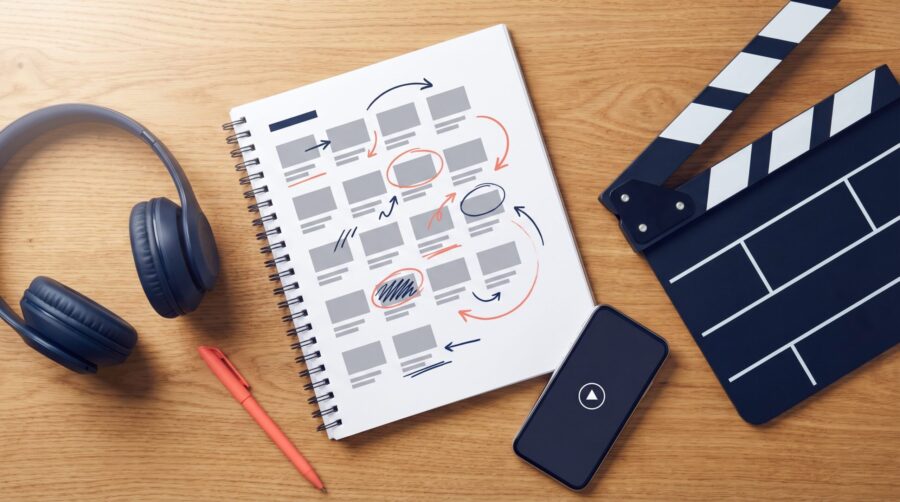
Not necessarily, but it helps. A storyboard maps each script beat to a specific visual, making production smoother. For simple text-on-screen trailers, a script alone is sufficient. For cinematic trailers with live footage or complex animations, a shot-by-shot storyboard prevents expensive reshoots and revision rounds.
How do I write a book trailer script without giving away spoilers?
Focus on the premise and the emotional stakes rather than plot events. A thriller trailer should make the viewer feel tension without revealing who the villain is. Use questions (“What would you do if…?”), sensory details, and the inciting incident only. Stop before the midpoint twist. If a line would ruin the reading experience, cut it.
Can I use dialogue from my book in the trailer script?
Yes, and it can be very effective. A single compelling line of dialogue, delivered as voiceover or displayed as text, gives the viewer a taste of your writing voice. Choose a line that is emotionally charged and makes sense without context. Avoid lines that require plot knowledge to understand.
Should I write different scripts for different platforms?
Ideally, yes. A 60-second YouTube trailer and a 15-second Instagram Reel serve different purposes and audiences. The YouTube version can be the full five-beat structure. The short-form social version should be a condensed hook-plus-CTA, essentially beats one and five from the full script. Writing both from the same source material is more efficient than trying to edit a long trailer down to 15 seconds.
How much does it cost to have a book trailer script written professionally?
Professional book trailer scriptwriting typically ranges from $50 to $300 as a standalone service, depending on the writer’s experience and whether the script includes a storyboard. Many trailer production companies include scriptwriting in their production package. If you are producing the trailer yourself using stock footage and text-on-screen tools, writing your own script using the structure outlined above is entirely feasible.
