
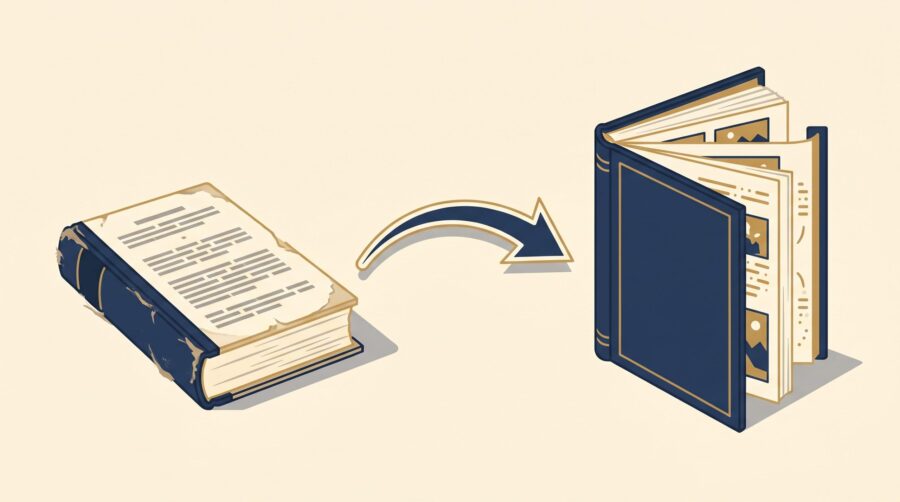
Rewriting a public domain book is only transformative enough to publish as your own when you add real, original authorship: new writing, original annotations, fresh illustrations, or a new translation. Cosmetic changes such as fixing spelling, swapping character names, or lightly paraphrasing give you no new copyright, and Amazon KDP will block an undifferentiated version if a free copy already exists.
How Much Do You Have to Change to Claim Copyright?
A public domain book is one whose copyright has expired, so anyone can use it freely. When you build something new on top of it, the result is called a “derivative work.” You own the copyright in your new additions only; you never own the original text, because that still belongs to everyone.
The legal bar for “new” is low but real. United States courts call it a “modicum of creativity,” a phrase from the 1991 Supreme Court case Feist Publications v. Rural Telephone Service. In plain terms, your contribution has to show a small spark of independent creativity. The U.S. Copyright Office explains in Circular 14 on derivative works that copyright protects only the material you actually added, not the public domain work underneath it.
This is why lawyers describe the protection on a rewrite as “thin.” If you add a new introduction and a set of study notes to an old novel, you own those notes; you do not own the novel. Someone else can take the same public domain novel, add their own notes, and sell it next to yours. Both of you are within your rights.
A common version of this is an author who has downloaded a free out-of-copyright text, changed the title and a few names, and assumed that effort alone created a brand-new book they fully own. It did not. Changes that small are treated as a copy, not a new work.
What Counts as Transformative Enough? A Practical Test
A rewrite is transformative enough when a reader who knows the original would recognise your version as a genuinely different book, not a lightly edited copy. The clearest test is to ask whether your new material could stand on its own as creative work. New chapters, a substantially new plot, original characters, expert commentary, or a fresh translation all pass. Reformatting, modern spelling, and renamed characters do not.
It helps to picture two ends of a scale. At the weak end: you take an old fairy tale, change “Gretel” to “Greta,” correct the punctuation, and add a one-paragraph foreword. That is cosmetic, and it adds nothing a court or a retail platform would treat as original. At the strong end: you retell the same fairy tale in a new setting, with new scenes, new dialogue, and a different ending. That is a new creative work you can clearly call your own.
The legal question is whether your edition adds genuine new authorship, not whether it merely repackages the original. The nonprofit Authors Alliance, writing on new derivative works built from the public domain, stresses that any copyright you gain covers only your original contributions. A useful rule of thumb is the “demonstrably different book” standard: if you cannot point to specific, substantial new authorship, you have a copy with extra steps.
Authors most often get caught out by quotation and plot. Reusing the original storyline beat for beat while changing the wording is rarely enough on its own; the protectable part is the new expression you bring, not the old structure you borrowed. When in doubt, write more original material, not less. (This is general information rather than legal advice; for a specific book, a copyright professional can tell you where your version sits.)
What Are Amazon KDP’s Rules for Public Domain Books?
Amazon KDP allows public domain books, but if a free version of the title is already in the store, KDP will only accept a “differentiated” version. According to KDP’s guidance on publishing public domain content, a differentiated edition must be one of three things: translated, annotated, or illustrated. Anything that only reformats or lightly edits the text is rejected.
Each route has a specific meaning on KDP:
- Translated: a new, original translation of the work. You must credit both the translator and the original author in the contributor fields.
- Annotated: original added content such as study guides, literary criticism, detailed biographies, or historical context. A short blurb does not count; the annotations need to be substantial.
- Illustrated: ten or more original illustrations that are relevant to the book. A single new cover image does not make a book “illustrated.”
KDP is explicit that a linked table of contents, tidied formatting, a new cover, or modernised spelling are not enough to differentiate a public domain title. The platform also requires you to flag the edition correctly: select “This is a public domain work” in the Publishing Rights section, put the matching tag such as “(Annotated)” or “(Illustrated)” in the title field, and begin the product description with a short bullet point (about 80 characters) that states what is original about your edition. Public domain content is also not eligible for KDP Select or every royalty option.
One point causes a lot of confusion: a “complete retelling” is not one of KDP’s three differentiation categories. If you genuinely rewrite a public domain story into a new creative work, KDP treats that as your own original book, so you would not tick the public domain box at all. You only use the public domain workflow when you are publishing the old text plus a translation, annotations, or illustrations.
Is the Book Actually in the Public Domain in Your Country?
A book is only safe to reuse if it is in the public domain in the country where you publish and sell, and those dates differ by country. Getting this wrong is the most expensive mistake in the whole process, because rewriting a book that is still under copyright is infringement no matter how much you change it. A common mistake is to check only the United States date and assume that a title which is free to download in one country is automatically clear to sell in another.
In the United States, the rule is currently date-based: as of Public Domain Day on 1 January 2026, works published in 1930 or earlier are in the public domain. Works published between 1923 and 1963 are a special case. Under the law then, copyright ran for an initial 28-year term and only continued if someone filed to renew it for a second term. The author could file that renewal, or, after the author’s death, their heirs could. If no one renewed it in time, the work fell into the public domain; if it was renewed, it stayed protected. Many copyrights from those years were never renewed, so a title may well be free to use, but you have to check the renewal records rather than assume either way. Cornell University Library keeps a widely used reference chart, Copyright Term and the Public Domain in the United States, that lays out these cutoffs clearly.
Most of the rest of the English-speaking world uses a life-based rule instead of a date. The UK, the European Union, and Australia generally protect a work for the life of the author plus 70 years. Canada extended its term from life plus 50 years to life plus 70 years on 30 December 2022, so works that cleared under the old rule stayed clear, but newer ones now take longer to expire.
There is one more trap, called the “rule of the shorter term.” The EU can apply the shorter of two countries’ terms to a foreign work, while the United States and Australia generally do not. The practical takeaway: confirm the author’s death date and the law of your selling market before you write a single new word, not after.
What Happens If Your Rewrite Isn’t Different Enough?
If your rewrite is not different enough, the most likely outcome is that your book is blocked or removed before it ever sells, and in worse cases your whole publishing account is at risk. KDP screens uploads with a mix of automated systems and human reviewers, and an undifferentiated public domain title is one of the patterns it looks for.
The milder result is a single blocked title: the book is held, you get a notice, and the listing does not go live. The more serious result is account-level action. Repeated or deliberate violations of KDP’s content guidelines can lead to a suspension or, in some cases, permanent termination, which also affects any other books in that account. Reinstatement usually requires a written “plan of action” and proof of your rights, which is slow and far from guaranteed.
There is also a quieter cost. If a reader buys your edition expecting something new and finds the same free text with a different cover, that “disappointing customer experience” tends to show up in one-star reviews, which drags down the listing even if Amazon never touches it. The fix in every case is the same: add genuine, substantial value, and describe honestly what is original about your edition.
If you want a sense of how careful self-publishers document rights and editions in general, our guide on whether you need to register copyright for your self-published book and the companion piece on what to put on your copyright page both cover the paperwork side. For the platform-disclosure mindset, our walkthrough on how to declare AI use on KDP shows the same honest-labelling principle in a different setting.
Frequently Asked Questions
Is changing character names enough to make a public domain rewrite original?
No. Changing names, fixing spelling, or lightly paraphrasing is treated as a copy, not a new work, so it gives you no new copyright and will not satisfy Amazon KDP’s differentiation rules. You need substantial original authorship, such as new writing, annotations, illustrations, or a translation.
What is the difference between a derivative work and a public domain work?
A public domain work is the original text whose copyright has expired, which anyone may use freely. A derivative work is something new you create on top of it. You own copyright only in your original additions to the derivative work, never in the underlying public domain text.
Do you tick the public domain box on KDP if you do a complete retelling?
No. If you write a genuine, substantial retelling, KDP treats it as your own original book, so you do not use the public domain workflow. The public domain checkbox and the (Translated), (Annotated), or (Illustrated) tags are only for editions that publish the old text plus that added element.
Does an annotated or illustrated edition count as transformative?
Yes, if the additions are substantial. KDP accepts annotated editions with original study guides, criticism, or historical context, and illustrated editions with ten or more original, relevant illustrations. A short foreword or a single new image does not qualify.
How do I check if a book is in the public domain outside the United States?
Most of the UK, EU, Australia, and Canada use a life of the author plus 70 years rule rather than a fixed date, so you need the author’s death year and the law of the country where you sell. Canada moved to life plus 70 years on 30 December 2022, and the EU can apply the rule of the shorter term to foreign works.
