
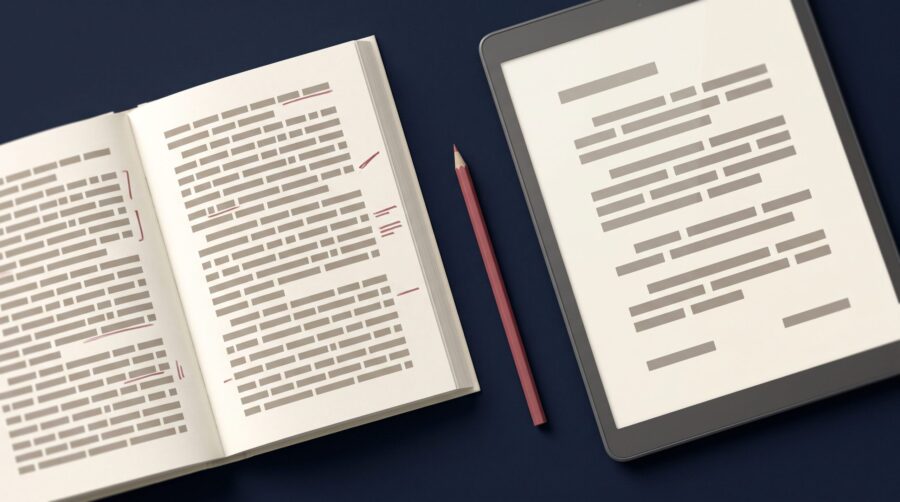
Yes: proofread the EPUB as well. The print PDF and the ebook are two different files, made by two different operations, so approving one tells you nothing about the other. What you need to check in the ebook depends on what it was built from: a Word file, a print PDF, or an InDesign document.
Why a Clean Print Proof Says Nothing About the Ebook
A print-ready PDF has been looked at more than once. In an outsourced workflow it is the main thing passing back and forth between author and formatter. If you are formatting the book yourself, you will have been staring at the page layout for several days. The design and the content on every page go through review and sign-off before the file goes to the printer.
The ebook is usually a later deliverable, made once print has its sign-off. Its content can differ from print for unintentional technical reasons, and its design will certainly change. The reader chooses the typeface, the type size, the line spacing, the margins, the screen it appears on, and whether the page is light or dark. Fixed-layout ebooks keep their design, but they are the exception rather than the norm.
An EPUB is a small packaged website, and like any well-made website it has to render correctly across devices and settings. Inside it sit the text as one or more web pages, a style file that controls the design of the content on screen, the images, a package file listing what the book contains, and a navigation file that drives the contents menu. A printed page cannot show you whether those web pages run in the right order, whether the contents links land where they should, or whether an italicized phrase arrived as italic.
The two files also come out of different operations. In a single-source workflow the print interior usually gets its sign-off first and you export the ebook from the same document afterward, so the ebook passes through a step the print proof never sees.
What Upload Checks Do and Do Not Cover
Uploading to a platform is a technical process, not an editorial one. The checks confirm that the file is valid and will load, and that the metadata is in order: title, author name, and the rest of the record. Some platforms add automated checks of their own and report what they find: Amazon KDP, for example, runs a spelling check on a Kindle ebook when you upload it, and shows you any potential spelling errors in the online Previewer before you publish. None of that amounts to anyone reading your book. IngramSpark states plainly that it has no proofing process for ebooks. And the print side is no different in kind: a proof tells you the file will print, not that the words are right. Proofreading the content, and satisfying yourself that the ebook gives a good reading experience, is yours to do.
What Most Often Goes Wrong, by Source File
The table below maps what most often goes wrong to the file you made the ebook from. Each row has a section in the rest of this article setting out the checks in full.
| If the ebook was made from | What most often goes wrong |
|---|---|
| A Word file | Corrupted or missing characters; chapter titles not tagged as headings, so the contents menu comes up short; body paragraphs with stray formatting; italics and bold that have dropped out because they were styled manually; long one-word headings running off the screen |
| A print PDF | Everything above, plus paragraphs split where they should not be, stranded hyphens, running heads and page numbers in the body text, passages in the wrong order, tables reduced to loose words, chapter headings the converter did not identify as structural elements for the contents menu |
| An InDesign document | Very little where styles, reading order, and anchored images were set up for export. Much the same as the Word list where the file was built by eye |
Not every ebook has all of these faults. Plenty come through clean, and a well-prepared file can sail past the whole list. At the same time, the list is not exhaustive: it is what has come up most often across twenty years of building ebooks and repairing broken ones for authors and publishers. Treat it as a set of things worth looking for, not a set of things to expect, while you read through the ebook, and know that all of these things are fixable.
Why One More Read Is Worth It
The message underneath the list of common ebook faults is simpler than its length suggests. Do not assume the ebook is right because the print book was. Give the book one more read, look at it on a couple of different devices, and click every menu and button to see that it holds up. That is a few hours of work, and you can spread the load by roping in family and friends. Anyone who reads ebooks knows how quickly a handful of formatting faults can pull you out of even a very good book. Platforms also usually pool reviews across a book’s formats. So a reader’s complaint about the ebook reading experience sits on the paperback’s listing too.
Check These First, Whatever the Ebook Was Made From
Some faults have nothing to do with the source file. They turn on how ebooks behave: a reading screen is often a fraction of the width of a printed page, and each reader will have their own device settings that make reading comfortable for them. Work this list on every ebook, then add the one that matches your source file.
Spacing, Tables, and Images
- Spacing and alignment made with spaces, tabs, and blank lines. Tapping the space bar until a line looks centered, or using a tab to indent the first line of a paragraph, produces a page that looks right in print. It does not survive into an ebook. The reader’s settings move the text around. And a converter often strips those spaces and tabs out altogether. Centered lines drift back to the left, and first lines lose their indents. The reader then loses the visual cues that tell them where they are on the page, which makes the book noticeably harder to scan. Set alignment, first-line indents, and the space above and below a paragraph in the paragraph style instead. You may have seen this problem yourself even in commercially published books.
- Wide tables and diagrams. A table that fits a 6-inch page can be unreadable on a phone. Judge it at different font sizes on screen, and if it is hard to read, consider restructuring it into fewer columns or supplying it as a picture with a written description. Do not leave a table or an image sitting in landscape orientation either: a reader who turns their device to read it will usually find the page turns with them, so the content stays sideways. We cover the detail in how tables convert in an ebook.
- Images that had text wrapped around them in print. Wrapping has no dependable equivalent in a reflowing file. When a converter carries the wrap across to the ebook, the image may end up partly cut off at the edge of the screen. The better result is usually to move the image between paragraphs, so the text runs above and below it.
Links, Notes, and Ornaments
- Web addresses. In a Word or InDesign source, an address inserted as a real hyperlink travels through conversion; one typed as plain text stays plain text, and you have to link it deliberately. A PDF is the opposite case: its tools detect common web address patterns in your text and tag them automatically, but they can miss addresses broken across two lines and addresses in justified text, where justification has stretched the spaces.
- Footnote and endnote links. Notes should work in both directions. Tapping a note number in the text should take you to the note, and tapping the number on the note should bring you back to where you were reading. Check several, from different chapters. Notes typed in by hand rather than inserted as real footnotes will have no links at all. And after a PDF extraction someone usually has to rebuild the return links one by one.
- Scene-break ornaments. An ornament placed as an image survives any route. Check how it looks in dark mode on a device, though, because it can show up sitting on a white background, or disappear entirely if its own color matches the background. An ornament that is a character from a decorative font maps to a letter inside that font, so when the font is missing the reader sees the letter instead of the flourish. To avoid both problems, consider replacing the ornament with the traditional centered line of three asterisks, which behaves like the rest of your text.
Page References, Chapter Files, and Title Details
- Cross-references to page numbers. An index and every cross-reference such as “see page 125” point at pages that stop existing once text reflows. Amazon’s text guidelines for reflowable books, as one worked example, tell ebook makers to take print page numbers out of the contents and hyperlink the headings instead. If your index entries carry several page numbers each, keep them, but link each number to the exact point in the text it refers to. Linking to the top of the print page is not enough. A single printed page can run across several screens on a device, so the reader lands near the reference rather than on it. That is a large job on a long index, and since e-readers let readers search the whole text, many publishers leave the index out of the ebook instead.
- Each chapter as a separate file. This one is not a visual check. An EPUB is a zip package, so seeing inside means unzipping a copy on your computer before you upload. It is worth doing if you can, as good hygiene. A book delivered as one long file looks no different to read. But an older e-reader can struggle with it, because it has to load and lay out the whole book in memory at once.
- Title and author name. Look at how the book appears in the reading app’s library, not only at what is inside the covers. The title and author sit in a separate file inside the EPUB, and some automated conversion pipelines do not pick them up correctly from the book itself. Check that what shows in the library matches your cover and the record you set up on the platform, because a mismatch can lead the platform to reject the file at upload.
Reading on Real Devices
- Two devices, several settings. Different reading apps do not render the same file identically. Even if you are publishing on only one platform, read the ebook in that platform’s app across at least two differently sized devices, such as a phone and a tablet. Change the type size as you go, and turn dark mode on and off. Accept as you do it that you have far less control over typography here than you had in print: a heading can end up stranded at the foot of a screen and there is little you can do about it. And never judge a reflowing ebook on its line or page breaks, because those belong to the reader’s settings, not to your book.
Made From a Word File? Five More to Check
These are the five faults we see most often in a Word-sourced ebook. Scanning for them first, fixing them in the Word file, and exporting again gives you a cleaner base for the full read. You still have to read the whole book. Clearing the structural faults first just means you can concentrate on the detail instead of the mechanics.
- Corrupted characters. A character in a file is a numerical code, and the font maps that code to the shape you see. Older symbol, dingbat, and foreign-language fonts map their codes differently, so the file can store one code and display something else. Look at accented letters, quotation marks, dashes, and any non-Latin text: wrong letters or empty boxes mean the code, not the shape, came through. The same mechanism is behind most of what happens to fonts in a Word to EPUB conversion.
- Chapter titles never tagged as headings. If you typed chapter titles as ordinary paragraphs and made them big and bold, the converter has nothing it can recognize as a chapter. The converter builds the contents menu from those headings, so the menu arrives short or empty, and the reader loses the quickest way around the book. Open the contents menu on a device and count the entries against your chapters.
- Body paragraphs that do not match each other. A paragraph style is a named set of formatting the converter carries across as one thing, and it is what gives a book its consistent feel. Without styles, a paragraph doing exactly the same job as the one above it can arrive looking different: a different indent, a stray gap above it, a size that shifts for no reason. Scroll through a few chapters and watch for paragraphs that break the rhythm.
Emphasis and Long Words in Headings
- Italics and bold applied by hand. A character style marks a phrase as emphasized, and a converter turns that character style into markup that carries over to the ebook. Emphasis applied manually in the source file is less reliable. Read a few passages you know have italic or bold type, to be sure it converted properly.
- Long single words in headings. It is not capitals as such that cause trouble; it is a long word that cannot break. ACKNOWLEDGMENTS has no break point, so on some devices it can run past the edge of the screen if your style sheet does not allow hyphenation. A BIG CAT is fine, because it breaks between words. Check your longest one-word headings at larger type sizes in your reading app.
Made From a Print PDF? Seven More Again
Ebooks sometimes start from a finished print PDF rather than from a manuscript, usually because the original files have gone missing. Everything in the Word list can happen here too, and seven more faults arrive on top.
The reason lies in what a PDF is for. A word processor stores your text as text: it knows where one word ends and the next begins, where a paragraph starts, and which line is a heading. A PDF stores a picture of the finished page. It knows where every piece of type sits and exactly how it looks, but not necessarily what any of it means or which pieces belong together.
Getting the text back out therefore means reconstructing it. Conversion tools are good at this and make informed guesses, but like a grammar checker they occasionally misread something a human reader would take in at a glance.
Seven Faults to Look For
- Paragraphs split where they should not be. A converter rebuilds paragraphs from printed lines, and now and then it misreads a line ending as the end of a paragraph. It is rarely every line, which is exactly what makes it easy to miss.
- Hyphens stranded inside words. A single word split across two printed lines can keep its hyphen in the middle; conversely, a converter can join up a hyphenated term at the end of a line into one word.
- Page furniture in the body text. Running heads and running feet carry the book title, the author name, or the chapter or section title at the top or bottom of every page. And the folio carries the page number. A converter may not be able to tell them from body text, so they land between your paragraphs.
- Text in the wrong order. Multi-column pages, pull quotes, sidebars, and captions can come back in the order the extractor found them, which is not always the order a reader would follow.
- Tables reduced to loose words. A table in a PDF is often just ruled lines with text positioned near them, so the cells can return as stray words with the structure gone.
- Wrong characters throughout. A PDF carries only the slices of each font it uses, and where that subset arrives without a map back to real characters, the extracted text is simply the wrong characters. We cover what this looks like in why your ebook looks wrong after converting from PDF to EPUB.
- Chapter titles the converter failed to identify. Headings in a PDF are visual rather than tagged, so a converter has to infer them from size and position. Where it cannot, tagging the chapters and splitting the file become manual work after extraction.
Why the Repairs Happen in the Output
One more thing separates a PDF extraction from the other routes: you can only make the repairs in the output, not the source. Free online converters do not let you see or change how they work, and their output varies with the algorithm each one uses. Give two of them the same PDF and you can get two different results, needing two different sets of fixes. A Word or InDesign source lets you correct the cause and export again.
Made in InDesign? The List Depends on How the File Was Built
An InDesign document can produce the cleanest ebook of the three routes, but only where someone prepared the file for it. Where it was not, the faults are much the same as a careless Word file’s. Professional software is not itself a safeguard. Ask whoever built the file to confirm four things.
Four Things to Confirm
- Styles mapped to export tags. InDesign can map its paragraph and character styles to ebook markup, so a chapter heading arrives as a heading and an emphasized phrase arrives as emphasis. Text formatted directly rather than by style gives the export nothing to map.
- A deliberate reading order. On a complex printed page a designer may use several separate text and image frames to position the content exactly. If the designer does not thread those frames together in the order a reader would follow, the ebook can jumble them up.
- Images anchored to their text. An image sitting loose on the page has nowhere specific to go in a file that has no pages. It can end up at the end of the chapter instead of at the point in the text where it belongs.
- Print-only adjustments removed. Building good pages leaves adjustments behind: a paragraph tightened so it shortens by one line and stops a single word stranding at the top of the next page, or a manual break keeping the sentence that introduces a list on the same page as the list. They serve a fixed page and mean nothing once text rewraps. A well-built file sheds them automatically, because the styles underneath survive.
Work the general list first, then the one that matches your source file. A Word or InDesign export gives you a short second list; a PDF extraction gives you a longer one, and you have to repair most of it in the output rather than at source.
Frequently Asked Questions
Is running EPUBCheck the same as proofreading your ebook?
No. EPUBCheck is a free validator, and it checks how the file is built: that the package holds together, that the information describing the book is present and correctly formed, that the code is correct, and that every internal reference points at something real. It has no opinion about a misspelled word, a paragraph that lost its italics, or a contents entry that points to the wrong chapter. Stores approve based only on validation, and readers notice the rest, so you need both. EPUBCheck is free from the W3C, and our guide to checking an EPUB someone else formatted shows how to run it without installing anything.
How do you point out a correction in an ebook that has no page numbers?
If you are working with someone else to build the ebook, bear in mind that the page and location numbers a reading app displays are not consistent from one app to another. Quoting one is therefore unreliable. The clearest approach is to send a screenshot or a photo of anything that looks wrong. For changes to the words themselves, copy and paste the whole block of text with the correction marked in it.
What if you find a mistake after the print file has already been approved?
Correct the mistake in the source file, then regenerate both editions from that source and check both again. Patching one output on its own makes the two versions drift apart, which is why a print-only error still costs you an ebook re-upload. Timings vary by platform. Amazon’s published timings, for example, say an updated ebook manuscript appears within 72 hours. An updated Read Sample, the free preview on the product page, takes 7 to 8 business days for an ebook and 9 to 10 for print.
Do you proofread a fixed-layout ebook the same way?
No. A fixed-layout ebook keeps its pages, so you proof it page by page and spread by spread, much as you would a print PDF. What you are checking is that nothing has disappeared or been corrupted during conversion, and that the pages are in the right order.
Does Amazon change your EPUB after you upload it?
Yes. Amazon converts the file you upload into its own Kindle format. Reflowable books uploaded as EPUB, DOC, DOCX, or HTML may receive Enhanced Typesetting, Amazon’s newer rendering system, while customers on older devices receive a KF8 version, an older Kindle format, instead. Those changes are technical rather than editorial: the platform is repackaging the file for its own devices, not rewriting your content. The effect we see most often is embedded fonts being stripped out. Check the result in the Online Previewer or in Kindle Previewer after uploading, and see Amazon’s Enhanced Typesetting help for the detail.
Can you hire someone to proofread only the ebook?
Yes. An ebook-only proofread is normal work, and it is usually quoted separately from a full manuscript proofread because it checks one output rather than reading the whole text again. Where the manuscript was already proofread before the formats branched, the ebook pass is short: characters, emphasis, headings, links, and navigation, read on real devices. Where it was not, the ebook pass turns into a full read and is priced accordingly.
