
A copy editor reviews your completed manuscript line by line, correcting grammar, punctuation, spelling, and syntax while ensuring internal consistency in character names, timelines, and style choices — all without rewriting your voice or altering your story’s structure. They work using Track Changes in Word so you can accept or reject every edit, and they deliver a style sheet documenting every decision they made.
- How Does Copy Editing Differ from Other Types of Editing?
- What Are the Four C’s of Copy Editing?
- What Are the Three Levels of Copy Editing?
- What Does a Copy Editor Actually Mark Up?
- How Does the Copy Editing Process Work for Self-Publishing Authors?
- How Much Does Copy Editing Cost and How Long Does It Take?
- Frequently Asked Questions
How Does Copy Editing Differ from Other Types of Editing?
Copy editing is one specific stage in a sequence of edits, and it addresses different problems than the stages that come before or after it. Understanding where it sits in the workflow prevents you from paying for the wrong service at the wrong time.
Developmental editing comes first and tackles big-picture issues: plot structure, pacing, character arcs, and overall argument. Line editing follows, refining prose style, sentence rhythm, and word choice at the paragraph level. Copy editing comes after both of those are resolved, focusing on sentence-level correctness and consistency. Proofreading is the final pass, catching any remaining typos or formatting errors in the laid-out file. For a deeper breakdown of these stages, see Developmental Editing vs. Copy Editing vs. Proofreading Explained.
The critical point for self-publishing authors: sending a manuscript to a copy editor before developmental and line editing issues are resolved wastes money. If whole chapters get restructured later, those carefully copy-edited sentences may end up deleted or rewritten.
What Are the Four C’s of Copy Editing?
Every copy editor’s work is governed by four core principles — Clarity, Coherency, Consistency, and Correctness — regardless of the manuscript’s genre or length.
Clarity means ensuring each sentence communicates its intended meaning without ambiguity. A copy editor flags awkward constructions, dangling modifiers, and unclear pronoun references that could confuse a reader.
Coherency addresses logical flow between sentences and paragraphs. The copy editor checks that transitions work, that cause and effect are sequenced properly, and that the reader can follow the argument or narrative without getting lost.
Consistency is perhaps the most labour-intensive part of the job. The copy editor tracks every spelling variant, hyphenation choice, capitalisation convention, and factual detail across the entire manuscript. If your character’s eyes are blue on page 12 and green on page 247, the copy editor catches it. They record all of these decisions in a document called a style sheet — a reference you and any future editors can use. For more on how style sheets work, see What Is a Style Sheet in Editing and Why Does Your Book Need One?.
Correctness covers grammar, punctuation, spelling, and adherence to whichever style guide governs the project — most commonly the Chicago Manual of Style for books published in the United States.
What Are the Three Levels of Copy Editing?
Copy editing is formally divided into three levels — light, medium, and heavy — and the level your manuscript needs depends on its condition when it arrives on the editor’s desk.
Light copy editing is appropriate for clean manuscripts that have already been through developmental and line editing. It corrects outright errors in grammar and punctuation, checks consistency in spelling and hyphenation, and verifies that formatting conventions are applied uniformly. The editor makes minimal changes to sentence structure.
Medium copy editing adds more active intervention. The editor may restructure awkward sentences for clarity, smooth transitions between paragraphs, flag potential factual errors, and tighten verbose passages. This is the most commonly requested level for self-published books.
Heavy copy editing approaches the boundary of line editing. The editor substantially rewrites unclear or poorly constructed sentences, reorganises paragraphs for logical flow, and may query the author about larger structural concerns. Heavy copy editing costs more and takes longer because the editor is doing significantly more work per page.
When requesting quotes from editors, specifying the level you need — or asking them to assess which level your manuscript requires after a sample edit — helps you get accurate pricing and avoids surprises.
What Does a Copy Editor Actually Mark Up?
A copy editor’s markup covers a specific, well-defined set of corrections and queries. Here is what they address in a typical manuscript:
- Grammar and syntax: Subject-verb agreement, tense consistency, sentence fragments, run-on sentences, misplaced modifiers, and parallel structure.
- Punctuation: Comma usage, em dashes vs. en dashes, semicolons, quotation marks (curly vs. straight), ellipses, and serial comma consistency.
- Spelling and word usage: Homophones (affect/effect, lay/lie), commonly confused words, and consistent spelling of proper nouns.
- Style guide adherence: Number formatting (spelled out vs. numerals), capitalisation conventions, abbreviation handling, and citation formatting, typically following the Chicago Manual of Style.
- Internal consistency: Character names, physical descriptions, place names, dates, timelines, and any factual claims that can be verified.
- Dialogue mechanics: Correct dialogue tag punctuation, attribution formatting, and consistent handling of interior monologue.
- Repetition: Overused words, repeated phrases, and echoes (the same word appearing too close together).
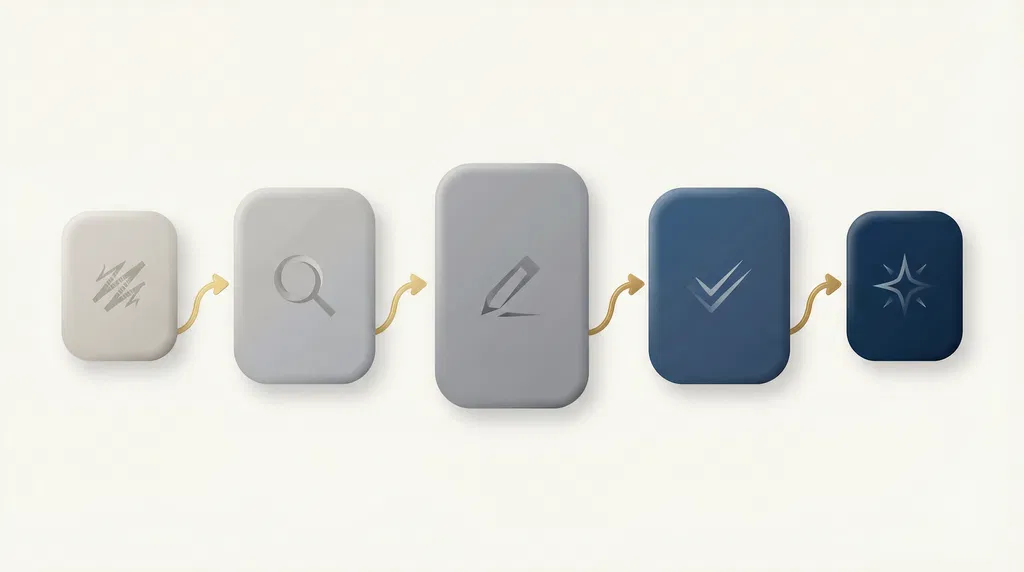
Equally important is what a copy editor does not do. They do not rewrite your prose, restructure chapters, develop characters, or fix plot holes. When they encounter a structural problem, they flag it with a query comment for the author to resolve.
How Does the Copy Editing Process Work for Self-Publishing Authors?
The standard workflow begins with you sending your completed, developmental-edited manuscript as a Word document. The copy editor works through the entire file using Track Changes, which records every insertion, deletion, and formatting change as a visible markup you can review.
Alongside the edited manuscript, your copy editor delivers an editorial style sheet. This document logs every decision made during the edit: whether you spell out numbers under one hundred or use numerals, whether “email” is hyphenated, how character names and place names are spelled, and any exceptions to the governing style guide. The style sheet becomes an essential reference if your book goes through additional rounds of editing or if you write a sequel.
Your job after receiving the edited manuscript is to go through every tracked change and either accept or reject it. Copy editors also leave comment bubbles — called queries — where they need your input on ambiguous passages, apparent contradictions, or choices that could go either way. Responding to these queries is essential; ignoring them often means errors survive into the published book.
Once you have accepted all changes and resolved all queries, the final step is to produce a clean file for upload. Platforms like KDP, IngramSpark, and Draft2Digital require submitted files to be free of tracked changes, comments, annotations, and stray metadata. Draft2Digital’s Knowledge Base explicitly states that authors must submit a fully edited manuscript — the platform provides no editing or proofreading services. KDP’s paperback guidelines similarly require files with no crop marks, bookmarks, comments, or placeholder text.
How Much Does Copy Editing Cost and How Long Does It Take?
Copy editing is typically priced per word, and rates vary based on the editor’s experience, the manuscript’s complexity, and the level of editing required.
Reedsy’s own figures put copy editing between $0.020 and $0.032 per word, averaging $0.027, which places an 80,000-word novel at roughly $1,600 to $2,560. The Editorial Freelancers Association breaks the same work down by category in its 2026 rate chart: fiction copyediting at $0.020 to $0.027 per word and nonfiction at $0.030 to $0.040. Those figures come from a survey of EFA members about the rates they charged during 2025, so read them as a baseline rather than a quote.
Timelines depend on the manuscript’s length and condition. A standard-length novel typically takes two to five weeks for copy editing, with complex or heavily marked-up manuscripts requiring up to eight weeks. Most editors offer a sample edit — usually of the first few pages — so both parties can agree on the level of editing needed and a realistic timeline before committing.
For context within a full editing pipeline, Reedsy’s data suggests the total professional editing suite for an 80,000-word book — editorial assessment, developmental edit, copy edit, and final proofread — runs approximately $8,640 combined. Copy editing represents roughly a quarter of that total investment.
A copy editor is not a luxury reserved for traditionally published books — it is one of the most practical investments a self-publishing author can make. The service catches errors you cannot see in your own work, produces a style sheet that keeps your manuscript internally consistent, and ensures the file you upload to KDP, IngramSpark, or Draft2Digital meets each platform’s submission requirements.
Frequently Asked Questions
Can I skip copy editing if I already used grammar-checking software?
Grammar-checking tools like Grammarly or ProWritingAid catch surface-level errors but cannot verify internal consistency, check factual accuracy, enforce a style guide across an entire manuscript, or build a style sheet. A copy editor catches context-dependent errors and continuity issues that automated tools miss entirely.
Do I need copy editing for a short ebook or novella?
Yes. Even a 20,000-word novella benefits from a professional consistency check. Shorter works are proportionally cheaper to copy edit since pricing is per word, and readers notice errors in short books just as readily as in long ones.
Should I format my book before or after copy editing?
Always copy edit before formatting. Interior formatting — whether for ebook or print — should be applied to a finalised, clean manuscript. If you format first, any changes from the copy edit may break your layout, requiring rework. Complete all editing stages, then move to choosing your trim size and formatting.
What is the difference between a copy editor and a proofreader?
A copy editor works on the manuscript before layout, correcting errors and ensuring consistency across the text. A proofreader works on the final formatted file, catching any remaining typos, formatting inconsistencies, or errors introduced during the layout process. They serve different purposes at different stages.
How do I know if my manuscript needs light, medium, or heavy copy editing?
Request a sample edit from your prospective editor. Most copy editors will edit a few pages at no charge or a small fee, then recommend a level based on what they find. If you have been through developmental and line editing, light or medium is usually sufficient. If you are skipping those stages, expect medium to heavy.
