
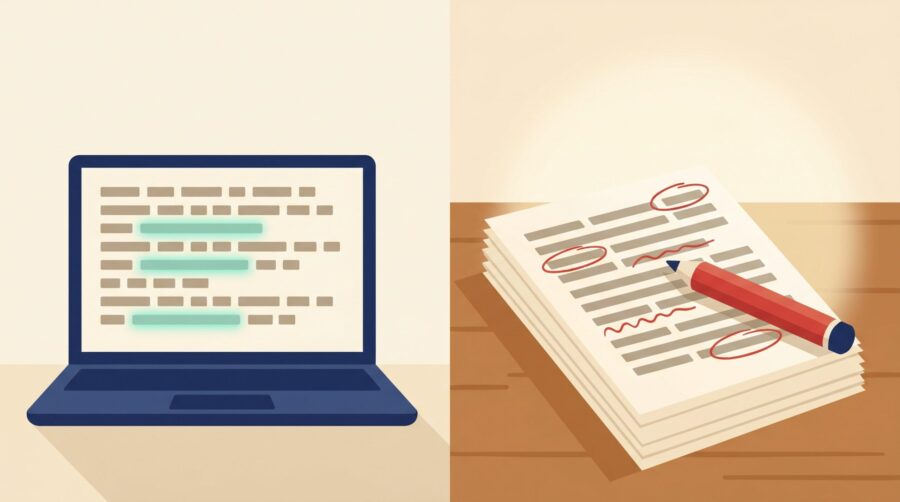
No. AI book editing tools cannot replace a professional book editor, but they have become useful assistants. Tools like Grammarly and ProWritingAid catch typos, grammar slips, and repeated words quickly and cheaply. What they cannot do is track your story, protect your voice, or take responsibility for the finished book. They work best combined: software first, human editor second.
- What Can AI Book Editing Tools Do Well?
- What Do AI Editing Tools Miss in a Book Manuscript?
- Can ChatGPT or Claude Edit a Full-Length Novel?
- Do You Have to Tell KDP or IngramSpark You Used AI Editing?
- Is Your Unpublished Manuscript Safe in an AI Tool?
- How Do Authors Combine AI Tools With a Human Editor?
- Frequently Asked Questions
What Can AI Book Editing Tools Do Well?
AI editing tools are fast, tireless, and consistent at surface-level correction: spelling, punctuation, grammar, and repeated words. A grammar checker will read your 90,000-word manuscript in minutes and apply the same rules to page 300 that it applied to page 3. Human eyes get tired; software does not. For a first cleanup pass, that consistency is a real advantage.
The two best-known tools take different approaches. Grammarly gives real-time suggestions as you type and is tuned for shorter business writing, such as emails and reports. ProWritingAid is built more for long-form work: its paid plan has no word-count limit, and it offers fiction-specific reports on pacing, sensory detail, and phrasing variety. Both also produce readability scores, which give you an objective measure of sentence length and complexity.
These tools also excel at mechanical consistency. For example, they will flag when you write “e-book” in one chapter and “ebook” in another, or when a sentence drifts into passive voice. Manuscripts that reach us after a ProWritingAid or Grammarly pass are noticeably cleaner at the sentence level, and that is exactly what these tools are for. The problems that remain sit at a level the software cannot see, which brings us to the limits.
What Do AI Editing Tools Miss in a Book Manuscript?
AI editing tools miss anything that requires remembering your story. They check text sentence by sentence, so they cannot track a character whose eye colour changes between chapters, a timeline that quietly skips a day, or a plot detail contradicted 40,000 words later. Continuity slips like these are the most common survivors of a software-only edit; the sentences are clean, but the story leaks.
Voice is the second blind spot. A grammar checker cannot tell an error from a choice. It will flag dialect in dialogue, sentence fragments used for pace, and rhythm choices that make your prose yours. Accept every suggestion in bulk and the writing comes out grammatically correct but flat. The tool is not wrong by its own rules; it simply does not know you had a reason.
There are also two quieter problems. First, AI suggestions can introduce new errors: an automated rewording can shift the meaning of a sentence in ways you only notice if you re-read carefully. Second, no AI tool takes responsibility for the result. A professional editor queries you when something is ambiguous, explains why a change matters, and answers questions after the edit. Software offers no conversation and no accountability, which matters when the book carries your name.
Can ChatGPT or Claude Edit a Full-Length Novel?
Not reliably in one pass. General-purpose AI chatbots such as ChatGPT, Claude, and Gemini can only hold a limited amount of text in working memory at once (the technical term is a “context window”). A typical novel runs 60,000 to 100,000 words. Some current models advertise windows large enough to fit that on paper, but in practice their attention to detail degrades as the input grows, so the model that critiques chapter one sharply may be skimming by chapter thirty.
The common workaround is chunking: feeding the manuscript to the chatbot a chapter or a scene at a time. Chunking works for line-level feedback, but it recreates the same continuity problem described above. The model editing chapter 12 has no memory of the promise your protagonist made in chapter 2, so cross-chapter inconsistencies pass straight through. Chunked sessions also drift in style; the suggestions you get on Monday’s chapters can follow different instincts than the ones from Friday.
Chatbots are stronger at big-picture conversation than at mechanical correction. Asking one to summarise a chapter, question a scene’s purpose, or list where a subplot appears can be a useful way to interrogate your own structure. Treat the output as a map to check, not a verdict to obey; these models present wrong observations with the same confidence as right ones.
Do You Have to Tell KDP or IngramSpark You Used AI Editing?
No, not for editing your own writing. Amazon KDP’s content guidelines distinguish between AI-generated and AI-assisted content. If you wrote the text yourself and used AI-based tools to “edit, refine, error-check, or otherwise improve” it, KDP classes that as AI-assisted, and no disclosure is required. Grammar checkers, spell checkers, and readability tools all fall on this side of the line. We cover the disclosure checkbox itself in our guide to declaring AI use on Amazon KDP.
The line moves if the AI creates the text. KDP defines AI-generated content as text created by an AI tool, and it stays AI-generated “even if you applied substantial edits afterwards.” So asking a chatbot to rewrite a chapter in different words produces AI-generated text that KDP requires you to declare, while asking it to point out weak sentences for you to rewrite keeps the work AI-assisted. The distinction is who produced the words, not how much AI was involved.
Other platforms draw their own lines. IngramSpark’s catalog integrity guidelines list content “created using automated means, including but not limited to content generated using artificial intelligence or mass-produced processes”, among the content it may remove from its catalog. Draft2Digital’s content guidelines state that AI-assisted content is supported but content generated entirely by AI without extensive human editing is not accepted. Under all three policies, the question is who created the text, not whether software helped you check it.
Is Your Unpublished Manuscript Safe in an AI Tool?
It depends on the tool and its settings, so check before you paste. The concern is real but specific: some AI services can use the text you submit to train or improve their models unless you opt out. For an unpublished manuscript, that is worth five minutes of reading the privacy policy, because you are handing over the complete text of a book that is not yet protected by publication.
Policies differ more than most authors expect. ProWritingAid states that it never uses your writing to train its AI models, and that text submitted for checking is removed from its servers once the analysis is complete. ChatGPT and Claude both offer settings that let you turn off the use of your conversations for model training; the default depends on your account type, so check rather than assume. Whatever tool you use, the practical rule is the same: find the data-use setting before uploading a full manuscript, not after.
A human editor, by contrast, works under an agreement. Professional editors routinely handle unpublished manuscripts under confidentiality terms, and many will sign a non-disclosure agreement if asked. Authors rarely think of confidentiality as part of what they are paying for, but it is part of the service.
How Do Authors Combine AI Tools With a Human Editor?
The pattern that works is AI first, human second. Run your manuscript through a grammar checker as part of your self-edit, fix the mechanical problems it finds, and send the cleaner text to a professional. The software handles the errors that are cheap to catch, and the human editor spends their attention on the things only a human can judge: story logic, voice, structure, and meaning. If you are new to the different levels of editing, our explainer on developmental editing, copy editing, and proofreading breaks down what each pass covers.
Professional editing is priced by the word, so it helps to know the going rates. The Editorial Freelancers Association’s 2026 rate chart, based on a survey of over 1,100 editorial freelancers, puts median copyediting rates for fiction at 2.0 to 2.7 cents per word, and developmental editing for fiction at 3.0 to 3.5 cents per word. For an 80,000-word novel, that is roughly $1,600 to $2,160 for a copyedit. An AI subscription costs a small fraction of that, which is exactly why the two get combined rather than compared; they do different jobs at different prices.
Be honest with yourself about the trade-off if budget forces a choice. A careful self-edit with AI support is far better than no editing at all, and for a free reader magnet or a low-stakes project it may be a reasonable stopping point. For a book you plan to sell, the errors that damage reviews are usually story-level and voice-level, which are the ones software cannot see. A professional copy editor also builds a style sheet as they work, recording every decision about your book’s names, spellings, and timeline; no current AI tool produces that, and it becomes the reference document for every later stage of production.
The answer to the question in the title, then, has two halves. AI tools have replaced a chunk of the mechanical work that used to eat an editor’s hours, and authors benefit from that. The judgement, the memory for story, the protection of voice, and the accountability remain human, and nothing on the market today changes that.
Frequently Asked Questions
Are there free AI tools that can proofread a novel?
Yes. Grammarly’s free tier, ProWritingAid’s free plan, and the Editor built into Microsoft Word all catch spelling and basic grammar errors at no cost. Free tiers limit either the depth of feedback or the amount of text processed at once, and none of them checks story continuity, so treat them as a first pass rather than a final proofread.
Can AI do developmental editing or analyse story structure?
Fiction-analysis tools such as AutoCrit and Marlowe from Authors A.I. generate reports on pacing, structure, and character presence across a full manuscript. These reports work well as maps that show you where to look, but the tools cannot judge whether a story works, and they need the author to interpret the results. Structural judgement still comes from a human: you, your beta readers, or a developmental editor.
Will AI editing tools change my writing voice?
They can, if you accept suggestions in bulk. Grammar checkers favour standard, efficient prose, so accepting everything tends to smooth out fragments, rhythm, and dialect that were deliberate. Review each suggestion individually and reject the ones that fight your style, and your voice stays intact.
Does AI-assisted editing count as AI-generated content on Amazon KDP?
No. Amazon KDP does not require disclosure for AI-assisted content, which covers using tools to edit, refine, or error-check text you wrote yourself. Disclosure is required only when an AI tool created the text, images, or translations, and that classification holds even after heavy human editing of the AI’s output.
Is an AI editor cheaper than a human book editor?
Per pass, yes, by a wide margin: a year of a premium grammar-checker subscription costs less than the copyedit of a single average-length novel at the median freelance rates reported by the Editorial Freelancers Association. The comparison misleads, though, because the products differ. The subscription buys unlimited surface-level checking; the professional fee buys story-aware judgement, a style sheet, and accountability for the result.
