
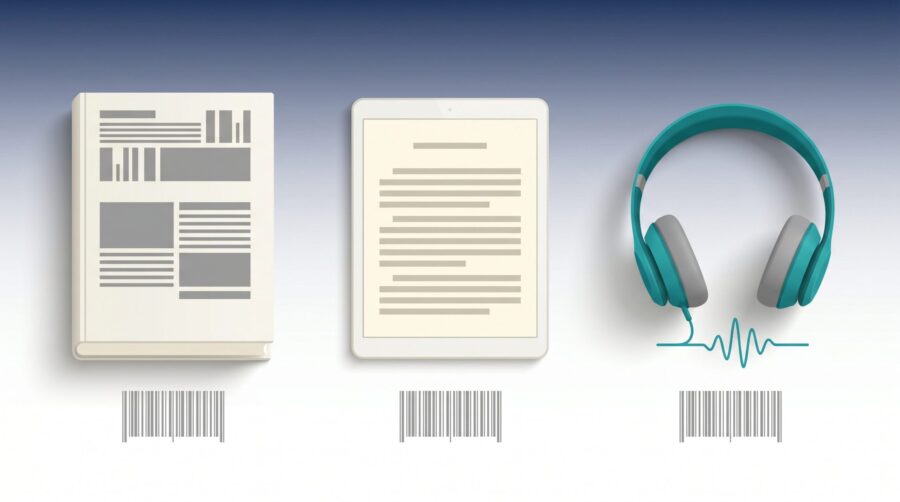
Whether you need a separate ISBN for your audiobook depends on where you plan to sell it. An audiobook counts as its own edition, so it needs its own identifier, separate from your print and ebook versions. If you publish only through ACX, Amazon assigns its own number (an ASIN) and no ISBN is required. For wider distribution, you supply your own audiobook ISBN.
Does an audiobook need its own ISBN?
An audiobook is treated as a separate product, so it needs its own ISBN, not the one you used for the print or ebook version. An ISBN (International Standard Book Number) is the 13-digit code that bookstores, libraries, and distributors use to identify one specific edition of a book. The rule that decides how many you need is simple: one identifier per format.
Think of the three main formats as three different products on a shelf. A paperback, an ebook, and an audiobook of the same title are sold, shipped, and shelved differently, so each gets its own number. This is the same reason a hardcover and a paperback of one title carry different ISBNs. The author asking “I want to market it as a book, ebook, and audio, do I need an ISBN for each one?” is really asking how many editions they are creating. The answer is three editions, so up to three ISBNs.
One pattern we run into often: an author buys a single ISBN for the whole project and assumes it covers every version. Then a library distributor or a retailer asks for the audio edition’s own number, and the author is stuck mid-upload. Knowing the one-per-format rule up front saves that scramble. It is also worth knowing that ISBNs never expire, so an identifier you assign to your audiobook today stays valid for the life of that edition. If you are still untangling how this works across stores, our explainer on whether you need separate ISBNs for KDP and IngramSpark covers the print and ebook side in detail.
Do you need an ISBN to publish on ACX?
No. You do not need an ISBN to publish an audiobook through ACX, the Audiobook Creation Exchange that distributes to Audible, Amazon, and Apple. ACX does not ask for one and does not provide one. Instead, the title is identified by an ASIN, Amazon’s own product number, which is created automatically when the audiobook goes live. Amazon’s ACX rights holder checklist lists what you actually need to submit, and an ISBN is not on it.
When you claim a title on ACX, you point it to the ASIN of your existing Kindle ebook, and ACX links the new audiobook to that listing. So if your audiobook lives only on Audible, you can publish start to finish without ever buying an ISBN. The trade-off is reach: an ASIN works only inside Amazon’s stores. The moment you want your audiobook in places ACX does not feed, an ASIN cannot travel with it.
A practical note from working with authors: people often hear “you don’t need an ISBN for an audiobook” and take it as a blanket rule. It is true only for ACX-exclusive distribution. The need for an ISBN is tied to your distribution choice, not to the audio format itself.
ISBN vs ASIN: what is the difference?
An ISBN is a universal, 13-digit identifier recognized by bookstores, libraries, and distributors worldwide. An ASIN is a 10-character code that only works inside Amazon. Both can point at the same audiobook, but they do different jobs, and one cannot stand in for the other.
Here is the cleanest way to keep them straight:
- ISBN — a universal identifier you buy from a national ISBN agency. One you own is portable across every retailer and library system that catalogs by ISBN. A free ISBN supplied by a distributor is usually tied to that distributor’s own distribution rather than freely portable (more on that below).
- ASIN — generated free by Amazon when a product is listed, tied permanently to Amazon’s platform, and not usable anywhere else.
This is why an audiobook can carry both at once. Inside Audible it is found by its ASIN; in a library catalog or a wide retailer it is found by its ISBN. If you only ever sell through Amazon, the ASIN is enough. If you want shelf space beyond Amazon, the ASIN does not get you there, which is the gap an ISBN fills.
Where do audiobook ISBNs come from?
Audiobook ISBNs come from one of two places: a national ISBN agency where you buy your own, or a distributor that assigns one to you. The route you pick affects who is listed as the publisher of record.
In the United States, Bowker is the only official source. A single ISBN costs $125, and a block of 10 costs $295, which brings the price down to $29.50 each. Because you need one per format, authors planning print, ebook, and audio editions often buy a block rather than single numbers. When you buy your own ISBN, you are listed as the publisher, and the identifier is yours to use on any platform.
Some distributors supply an ISBN at no cost instead. Voices by INaudio, the wide audiobook distributor that took over Findaway Voices’ non-Spotify distribution after Findaway Voices closed in August 2025, assigns a complimentary ISBN to titles it distributes. The catch is ownership: an ISBN supplied by a distributor lists that distributor as the publisher of record, and it is generally tied to their distribution rather than free for you to carry elsewhere. That is not necessarily a problem; it is simply a difference worth understanding before you choose. If the idea of a free, distributor-assigned identifier is new to you, our guide to free ISBNs and the trade-offs that come with them walks through the same decision for print and ebook.
How do you get an audiobook ISBN outside the United States?
Outside the United States, you get an audiobook ISBN from your own country’s national ISBN agency, and the cost varies widely from free to a per-block fee. Each agency treats an audiobook as a separate format that needs its own number, just as Bowker does.
A few examples show the range:
- Canada — ISBNs are free. Library and Archives Canada issues them at no charge to eligible Canadian publishers, and it explicitly covers audiobooks alongside print and ebooks. You apply for an account online; processing can take several weeks.
- United Kingdom — ISBNs are purchased from Nielsen, the agency for the UK and Ireland. A single ISBN runs roughly £89 to £93 at the time of writing, with cheaper per-unit pricing in blocks of 10 or 100. Audiobooks for download or on physical media are eligible.
- Australia — ISBNs are bought from Thorpe-Bowker, with single numbers and blocks available and a one-time setup fee for first-time publishers.
Because rules and prices differ by country, the safe first step is to find your national agency rather than assuming you must pay Bowker’s US rate. Several countries beyond Canada issue ISBNs for free, so where you live can change the math considerably. If you are weighing the 10-digit and 13-digit forms you may see during signup, our breakdown of ISBN-10 vs ISBN-13 clears that up.
What happens if your audiobook has no ISBN?
If your audiobook has no ISBN, nothing breaks on Audible, but several other doors stay closed. Inside Amazon’s stores, the ASIN does all the identifying work, so an Audible-only release runs perfectly well without an ISBN. The problems start the moment you try to go wider, because many libraries, retailers, and distributors catalog titles by ISBN and will not list a product that lacks one.
The international standard that governs these numbers, administered worldwide by the International ISBN Agency, treats every distinct format and edition as its own product, so each version is found and tracked separately through the supply chain. Without that number, your audiobook is harder for a library system to order, harder for a store’s database to slot in, and harder for sales-tracking services to record.
Waiting is fine: an audiobook that starts out exclusive to Audible can always be assigned an ISBN later if you decide to go wide. The useful thing is to treat the number as a known step for wide distribution, so it becomes a planned cost rather than a surprise at the point of upload.
The short version: an audiobook is its own edition, so it gets its own identifier. If you stay exclusive to ACX, Amazon’s ASIN handles that and you can skip the ISBN entirely. The day you go wider, you will need an ISBN, whether you buy your own or accept one from a distributor, so it is worth deciding which route you want before you upload.
Frequently Asked Questions
Do I need a different ISBN for each format of my book?
Yes. Print, ebook, and audiobook are each a separate edition, so each needs its own ISBN if you use ISBNs at all. A hardcover and paperback of the same title also take different numbers. One identifier per format is the rule.
Does Audible give my audiobook an ISBN?
No. Audible and ACX identify audiobooks by an ASIN, Amazon’s own product number, which is created automatically. They neither require nor supply an ISBN, so an ACX-only audiobook can be published without one.
Is an ASIN the same as an ISBN?
No. An ISBN is a universal 13-digit code recognized by retailers and libraries everywhere. An ASIN is a 10-character code that works only inside Amazon. They can both point at the same audiobook, but an ASIN cannot be used for distribution outside Amazon.
Can I get a free ISBN for my audiobook?
Sometimes. In Canada and several other countries, the national agency issues ISBNs for free, including for audiobooks. Some wide distributors also assign a complimentary ISBN, though that lists the distributor as the publisher of record.
Do I need an ISBN if I only publish my audiobook on Audible?
No. ACX-exclusive distribution to Audible, Amazon, and Apple relies on an ASIN, so no ISBN is needed. You only need one when you distribute the audiobook to libraries or retailers that catalog by ISBN.
