
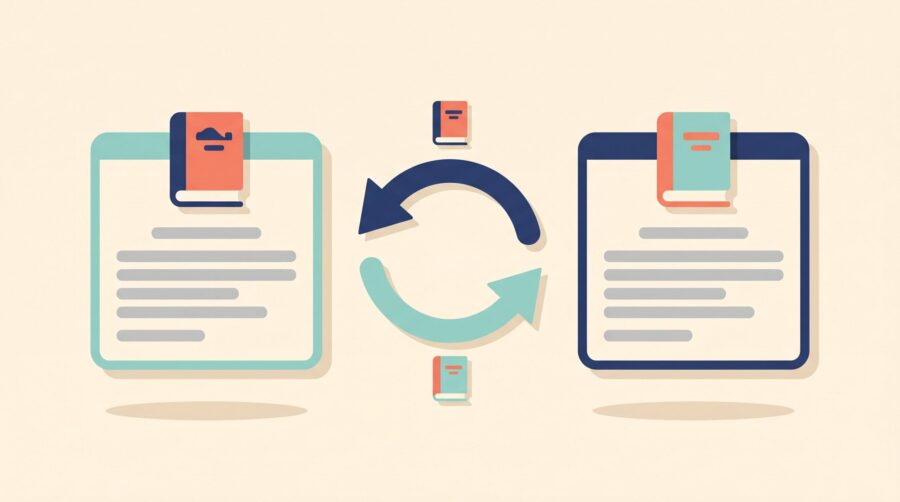
A newsletter swap is a free arrangement where two indie authors agree to promote each other’s book or reader magnet to their own email lists. You exchange a short blurb, a cover image, and a link; you never share subscriber names or addresses. It is one of the lowest-cost ways for a self-published author to reach new readers who already buy books in your genre.
What Is a Newsletter Swap?
A newsletter swap is a mutual promotion between two authors: you feature their book in your email newsletter, and they feature yours in theirs. The only things that change hands are the promotional materials, a cover image, a few lines of copy, and a link. This is the part that trips up most authors who are new to the idea, so it is worth stating plainly: you do not send your subscriber list to the other author, and they do not send theirs to you. Each of you simply mentions the other’s book to the readers who already chose to hear from you.
That distinction matters for trust and for the law, which we cover further down. Sharing or selling email addresses without consent breaks data-protection rules and, just as importantly, breaks faith with readers who signed up to hear from one specific author. A swap keeps everyone’s list private while still putting your book in front of a fresh, engaged audience.
Swaps work best between authors writing in the same or a closely related genre, because a thriller writer’s readers are far more likely to click on another thriller than on a cookbook. A romance list and a hard science fiction list can both be large and engaged and still send each other almost no clicks.
1:1 Swaps vs. Group Promos: What’s the Difference?
A one-to-one swap involves just two authors who each mention the other’s book on an agreed date. A group promo (sometimes called a multi-author promotion) gathers many authors onto a single shared landing page, and every participant promotes that one page to their list. Both run on the same principle of mutual reach, but they suit different goals.
| Feature | 1:1 newsletter swap | Group promo |
|---|---|---|
| Authors involved | Two | Many (often 10 to 50) |
| Where readers land | Inside your newsletter, then your book page | A shared landing page listing every book |
| Best for | A precise, on-genre match | Fast email-list growth at scale |
| Coordination | Direct email between two authors | Usually managed through a platform |

Group promos are popular for list building because readers usually have to enter their email address to download the free books on the shared page, which adds new subscribers to every participating author at once. One-to-one swaps tend to convert better per reader because the recommendation feels personal and the genre match is tighter. Note that swaps assume you already have a list to swap with; getting those first subscribers in place is a separate job, which we cover in our guide to building a pre-launch email list.
Two tools handle most of the coordination work for indie authors, and it helps to look at them factually rather than asking which is “best.” BookFunnel began as a secure book-delivery service and adds a swap board, group promos, and click tracking; its author plans start at $30 per year as of February 2026, with swaps and group promos included from the entry plan. StoryOrigin offers a swap marketplace with genre filters and visible click history, with a free tier that includes swap participation and a standard plan at $10 per month or $100 per year. You can also run a swap with nothing more than two emails and a calendar; the platforms simply make matching and tracking easier as your number of swaps grows. A pattern worth noting: authors who try to schedule more than a handful of manual swaps a month usually reach for one of these tools, because keeping the dates, assets, and follow-ups straight by hand becomes the real bottleneck.
How Do You Find and Vet Swap Partners?
You find swap partners in two ways: through authors you already know, and through dedicated swap boards. The simplest starting point is your own network, writers you have met in genre Facebook groups, on author forums such as kboards, or through a writing community. From there, the swap marketplaces inside BookFunnel and StoryOrigin let you search for authors by genre and audience size and request a swap directly. Starting with someone you know lets you work out any kinks before approaching a stranger.
Vetting matters more than most new authors expect, because a swap puts your name in front of someone else’s readers and theirs in front of yours. Check three things before you agree:
- Genre fit: their readers should plausibly want your book. A cozy-mystery list is a poor match for grimdark fantasy, even if both authors are lovely people.
- List engagement, not just size: a smaller, active list often outperforms a large, dormant one. According to email platform MailerLite, author and book newsletters see benchmark open rates above 40% and click rates around 2.75%, which is high compared with many industries. If a potential partner is happy to share their numbers and they sit near or above those marks, the list is healthy.
- Content suitability: read a little of their book. You are recommending it to your readers, so it should match the tone and content they expect from you.
There is no hard minimum list size; a few hundred engaged subscribers is enough to start, and many authors run their first swaps well before they hit a thousand. The common mistake we see authors make is chasing the largest list they can find and then feeling deflated when a big but disengaged audience sends almost no clicks. Engagement beats raw numbers nearly every time, which is why the open and click rates above are worth more than a subscriber count.
What Goes in a Swap Package?
A swap package is the small bundle of assets you send your partner so they can promote your book with no extra work. At minimum it contains your book cover image, a one-line tagline, a short blurb of roughly 60 to 120 words, and a direct link to your book’s sales page or to the reader magnet you are offering. Many authors also add a short author bio and their social links so the partner can tag them.
Keep the blurb tight and tailored. A swap mention usually sits in the lower half of a newsletter, often under a friendly heading like “Books my readers might enjoy,” so it competes for attention with the author’s own content. The copy you would paste into an Amazon listing is not always the copy that fits a personal email; if you have already written a strong book description, trim it to a punchier version for the swap. A frequent misstep is handing a partner a long, formal product description that reads nothing like the rest of their warm, chatty newsletter; the mismatch makes the recommendation feel like an advert and readers skip it.
Here is what a clean swap blurb looks like in practice:
Cover image | If you liked last week’s pick, try this.
A retired detective takes one last case in a snowbound village where everyone has something to hide. Quiet, twisty, and over before you want it to be. Free this week.
[Read it here]
Notice that it leads with the reader, names a clear hook, and ends with a single obvious link. The platforms hand you a form to upload these same assets, so building one reusable swap package saves you time on every future swap. One more practical note about the link you hand over. If you earn commission through Amazon Associates, your tagged affiliate links are allowed in email: Amazon’s rule is that they may only be sent to people who opted in to hear from you and who can easily opt out, which an ordinary author newsletter already satisfies. The catch in a swap is the disclosure that travels with the link. Wherever an affiliate link appears, the line “As an Amazon Associate I earn from qualifying purchases” has to appear too, and in a swap that lands on your partner’s newsletter rather than your own. Giving your partner a plain Amazon product link, or a universal book link covering every retailer, keeps both newsletters clean.
Is It Legal to Email Your List About Another Author’s Book?
Yes. Emailing your own subscribers about another author’s book is perfectly legal, because those readers opted in to hear from you and you are the one sending the message. What you must never do is import or email the other author’s subscribers; that is the line a swap is designed not to cross. As long as each author mails only their own list, a swap stays firmly inside the rules.
Two frameworks govern author email, and both are easy to meet. In the United States, the CAN-SPAM Act requires every commercial email to include a valid physical postal address and a clear, working unsubscribe option, and it requires you to honour opt-out requests within 10 business days. In the European Union and the United Kingdom, the GDPR requires explicit opt-in consent, with no pre-ticked boxes, and that you keep a record of that consent. A reputable email service such as the one you already use for your list handles the unsubscribe link and address block for you, so meeting these rules is mostly a matter of not turning those features off.
The reason these protections exist points back to the core etiquette of swaps: reader trust is the whole asset. An author who quietly added a swap partner’s subscribers to their own list, or who recommended a book they had not even skimmed, would burn that trust fast. Keep each list private, recommend only books you would genuinely hand to a friend, and a swap stays both legal and welcome.
A newsletter swap is one of the few marketing tactics that costs nothing, respects reader privacy, and grows stronger the more genre peers you know. Start with one author whose books you genuinely admire, agree on a date, trade a tight swap package, and measure the clicks. Do that a few times and you will have built both a small circle of reliable partners and a steady new source of readers.
Frequently Asked Questions
Do newsletter swaps cost money?
The swap itself is free; you and your partner are simply trading space in newsletters you already send. Coordination tools are optional. BookFunnel’s author plans start at $30 per year and StoryOrigin offers a free tier plus a standard plan at $10 per month or $100 per year, but you can run swaps by hand at no cost.
What is the difference between a newsletter swap and a paid newsletter promotion?
In a swap, two authors promote each other for free and no money changes hands. In a paid newsletter promotion, you pay a service to feature your book to its own large subscriber list. Swaps build reciprocal relationships; paid promotions buy one-way exposure.
Can you run a newsletter swap without BookFunnel or StoryOrigin?
Yes. A swap needs only two willing authors, agreed dates, and a swap package for each. Platforms make finding partners and tracking clicks easier, especially once you run several swaps a month, but they are not required to get started.
How often should authors do newsletter swaps?
There is no fixed rule; it depends on how often you email your list and how much your readers tolerate recommendations. Many authors include one swap mention per newsletter or cluster several around a new release or a free-book promotion. Keep your own content the main event so swaps feel like a bonus, not clutter.
