
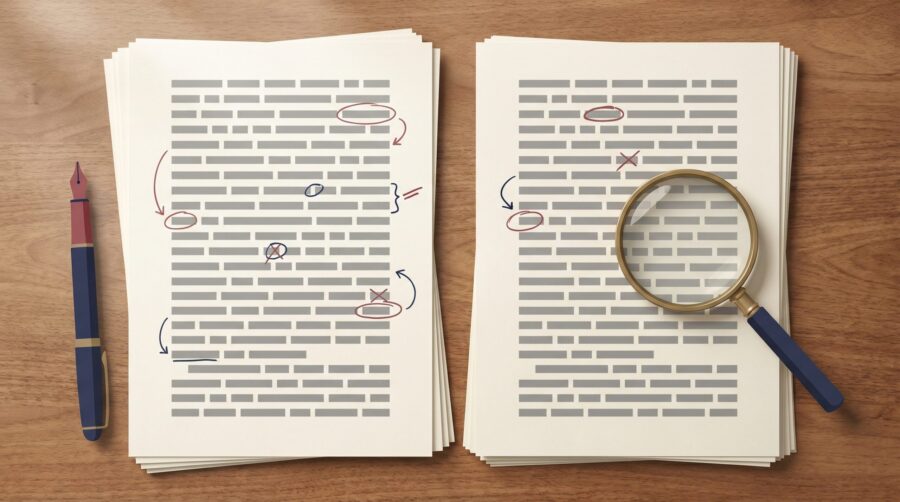
A sample edit is a short trial edit, usually a few pages of your manuscript, that a prospective editor marks up so you can see how they work before you hire them. You use it to judge their skill, their communication, and whether they fit your voice, and to compare editors fairly by sending each one the same passage.
What is a sample edit, and what should it include?
A sample edit (also called a trial edit) is a small section of your manuscript edited by someone you are thinking of hiring. It does the same job a test drive does for a car: it shows you how the editor actually works on your words, not just what their website promises. Most samples run to roughly five standard pages, or about 1,000 to 2,000 words.
A useful sample shows its reasoning, not just its corrections. You should be able to see every change the editor made, usually through Microsoft Word’s Track Changes, so nothing is altered silently. Alongside the changes, a good sample includes short margin comments that explain the reasoning behind the bigger calls, and often a brief note summarising the editor’s overall impression of the writing. If you have never opened a tracked file before, our guide on how to handle track changes from your editor in Word walks through reading and responding to one.
The reason to ask for a sample at all comes back to how the editing profession works. There is no licensing body for editors, as the Chartered Institute of Editing and Proofreading (CIEP) notes, so anyone can offer the service; a sample lets you judge an editor on results rather than claims. One thing worth knowing from the work we do: the most helpful samples are not the ones with the most red ink, but the ones that explain why a change was made, because that reasoning is what you will rely on across a whole book. Used well, a sample edit is the single best tool an author has to vet an editor and choose the right one with confidence rather than guesswork.
Are sample edits free or paid?
Both free and paid sample edits are normal, and a fee is not a warning sign. Many editors offer a short sample at no charge as a way to win new clients, while others charge for the time it takes. The Editors Canada blog notes that a sample, paid or unpaid, still costs the editor real working hours, which is why busy professionals often ask for a fee.
When an editor does charge, it is common for that fee to be folded into the full project price if you go ahead, so you are rarely paying twice. Some editors also charge to discourage what the trade calls a “frankenedit,” where an author collects free samples from many editors and stitches the corrections together instead of hiring anyone. Knowing that background helps you read a fee as a practical choice rather than a red flag.
Focus on what the sample contains, not what it costs. A thoughtful paid sample that explains its changes tells you far more than a rushed free one. If you are still weighing up which level of editing you need and what it should cost, our breakdown of how much book editing costs and which type you need sets out the going rates first, so a sample fee has a sensible reference point.
Which pages should you send for a sample edit?
Send a passage that is typical of your writing and a little demanding, not your most polished opening. Opening chapters are usually the most rewritten part of a book, so they make almost any editor look good and tell you the least about how someone handles your messier middle. A scene with dialogue, a shift in tone, or a tricky structural moment gives a far more honest picture.
If you are approaching more than one editor, send all of them the same pages. The Editorial Freelancers Association (EFA) recommends keeping an unpaid sample to a manageable length, around five standard pages, and sending the same portion to each editor so you are comparing like with like. Different passages would make the comparison meaningless, because one editor might simply have drawn an easier stretch of prose.
The most common mistake we see is authors submitting their hard-won first page to several editors and then struggling to tell the results apart. A representative chunk from the middle of the manuscript, where the writing is rawer, separates a careful editor from a quick one much more clearly. Before you send anything, it also helps to self-edit your manuscript so the sample reflects your real writing rather than avoidable typos.
How do you compare editors from their sample edits?
Compare samples on a few clear points rather than a general gut feeling. Look at whether the corrections are technically accurate, whether your voice still sounds like you after the edit, whether the editor explains the significant changes, and whether their comments are clear and respectful. An editor who quietly rewrites your sentences into their own style is a poorer fit than one who fixes errors and suggests options.
It helps to score every sample against the same short checklist:
- Accuracy: are the grammar, spelling, and punctuation fixes correct, without any new errors introduced along the way?
- Voice: does the passage still read like you, or has it been smoothed into the editor’s own style?
- Reasoning: do the comments explain the bigger changes, rather than just marking them?
- Scope: did the editor stay at the level you asked for, instead of straying into a different kind of edit?
- Tone: are the notes clear, specific, and respectful of your work?
Watch out for one trap when you compare: an editor making a correct, consistent choice can look like they are “wrong” if it clashes with a habit of yours. Editors Canada makes the same point, noting that an author’s own assumptions about what is correct can unfairly colour how they judge each sample. Agreeing the style guide and your brief up front, before the sample, keeps the comparison fair.
Tone of communication counts too, because you will be working with this person for weeks. If a sample’s comments read as collaborative and specific, that usually carries through the whole project. Score each editor on the same handful of points, set them side by side, and the right fit tends to stand out rather than needing a coin toss.
Does a sample edit differ by editing type?
Yes, and this is the step authors most often skip: work out which type of editing you need before you ask for a sample, or the sample will measure the wrong thing. A copy-editing sample shows sentence-level accuracy; it will not reveal whether an editor can diagnose a sagging plot. Our explainer on developmental editing, copy editing, and proofreading helps you pin down the right level first.
The three main levels each produce a different kind of sample. A copy-editing or line-editing sample comes back as tracked changes on your pages, often with a short style sheet listing the editor’s spelling and formatting choices. A proofreading sample is lighter, a marked-up version of near-final pages catching stray typos and slips.
Developmental editing is the exception, and it is the one authors most often misjudge here. You cannot assess big-picture structure, plot, or pacing from five pages, so developmental editors rarely offer a short sample edit at all. The closest equivalent is a manuscript assessment (sometimes called a manuscript evaluation): a paid read of the whole book that comes back as a structured editorial report rather than line edits on a passage. If that is the help you need, a five-page sample is the wrong test; the manuscript assessment is the thing to ask for.
So match the request to the stage your book is at. Asking a developmental editor for tracked line-edits on five pages, or asking a proofreader to comment on your plot, sets everyone up to be judged on the wrong skill.
What a sample edit can’t tell you
A sample is powerful, but it has a narrow view. It shows skill, style, and communication on a few pages; it cannot show whether an editor will hold consistency across an entire manuscript, meet your deadline, or manage a longer project smoothly. Those are real risks that a short extract simply does not test.
Cover them separately. Ask about the editor’s current availability and turnaround, confirm the scope and rates in writing, and agree how queries will be handled during the job. The sample tells you whether someone can edit your pages well; a short conversation about schedule and process tells you whether they can carry your whole book.
Frequently Asked Questions
Is it OK to send the same pages to several editors at once?
Yes. Sending the same passage to each editor is the fairest way to compare them, and most editors expect authors to be shopping around. Be upfront that you are gathering a few samples; professionals are comfortable with it.
Is it a red flag if an editor charges for a sample edit?
No. Charging for a sample is common and legitimate, especially among editors in demand, and the fee is often deducted from the full project price if you proceed. Judge the quality and clarity of the sample, not whether it carried a charge.
What are the real red flags in a sample edit?
Watch for vague comments with no reasoning, changes that rewrite your voice into the editor’s own, no tracked changes so you cannot see what was altered, or obvious errors left uncorrected. Any of these tells you more than the price ever will.
How long should a sample edit take to come back?
A few pages usually take anywhere from a few days to a couple of weeks, depending on the editor’s current workload. Ask for a rough timeframe when you request the sample, since their responsiveness now is a preview of how they will communicate during the job.
Can a sample edit tell me if an editor is right for my whole book?
It tells you most of what matters: skill, style fit, and communication. It does not show scheduling, consistency across a full manuscript, or project management, so confirm those points in a short conversation before you commit.
