
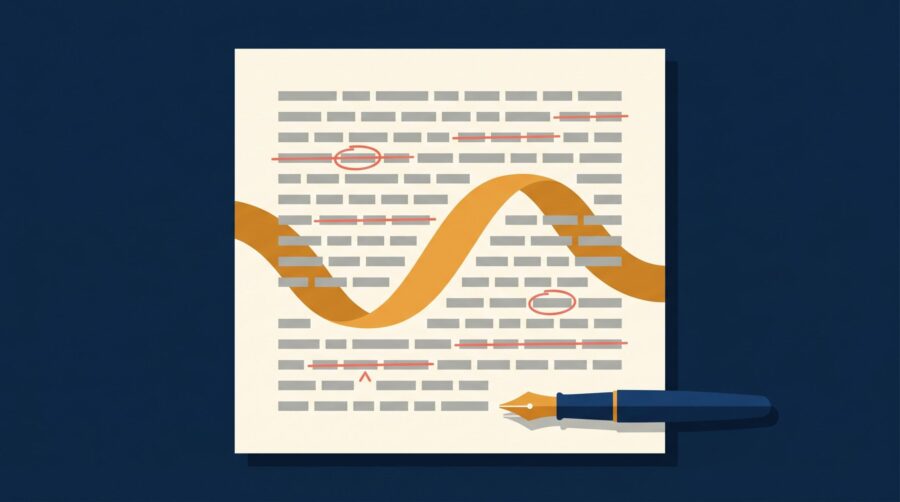
Professional editing should not change your voice or writing style. A good editor corrects errors, improves clarity, and questions anything unclear while protecting the way you naturally write. Every edit comes back as a tracked suggestion with the reasoning attached, and you can accept or reject each one, so the final say on every sentence stays with you.
Which Level of Editing Could Change Your Voice the Most?
Line editing works closest to your voice; developmental editing shapes the story around it; copyediting touches it lightly; and proofreading barely touches it at all. Knowing which level you are buying tells you how much contact your prose will have with another person’s judgement.
Editors work at four broad levels, and each one has a different job. The Chartered Institute of Editing and Proofreading (CIEP) describes copyediting as checking grammar, spelling and punctuation, applying consistency, and making sure the text is clear for its intended reader. In the traditional workflow, copyediting comes after developmental and line editing, and proofreading is the final check after the book has been formatted.
| Editing level | What it works on | Contact with your voice |
|---|---|---|
| Developmental editing | Structure, plot, pacing, and content | Indirect: it questions what you say more than how you say it |
| Line editing | Sentence rhythm, word choice, and flow | Highest: it works inside your phrasing, sentence by sentence |
| Copyediting | Grammar, spelling, punctuation, and consistency | Light: it fixes mechanics and queries anything judgement-based |
| Proofreading | Typos and layout slips in the formatted book | Minimal: it corrects outright errors only |
The fear of losing your voice usually attaches to the wrong level. Copyediting deals mostly in mechanics: commas, consistency, and typos that you would want fixed anyway. Line editing is where a second pair of hands genuinely enters your phrasing, which is why it should only happen when you have asked for it. For a fuller breakdown of the levels, see our guide to developmental editing, copy editing and proofreading.
One pattern from the manuscripts we edit is worth knowing: budgets usually stretch to a single professional round, so the practical decision is not “how many stages” but which level serves the book best. When you compare quotes, ask each editor to name the level they are quoting for. As a reference point, the CIEP estimates that an experienced professional copyedits roughly 1,000 to 3,000 words per hour on a reasonably clean text, so a quote that promises much more, much faster, deserves a follow-up question.
How Do Editors Protect Your Voice While They Work?
Professional editors follow a simple discipline: learn the writer’s style before changing anything, edit with restraint, and record deliberate choices on a style sheet so they are protected rather than “corrected”.
ACES: The Society for Editing lays this out as a three-step process: identify the voice by reading before editing, edit carefully, and review the finished edit to confirm the voice survived. The same piece makes a point that explains the whole topic: no single edit hurts a voice, but many small changes together can, the way single drops of food colouring eventually turn a bucket of clear water blue. Good editors watch for that cumulative drift.
The style sheet is the working tool behind this. It is a running list of decisions about your book: spellings, hyphenation, character details, and, crucially, the rules you break on purpose. Sentence fragments used for pace, dialect in dialogue, and unconventional punctuation all belong on it, marked as deliberate. If you break a rule on purpose, say so up front; a one-line note such as “fragments are intentional in interior monologue” saves dozens of queries later and removes any chance of a well-meaning correction.
The same briefing works in the other direction. Some habits are not choices: a word you lean on without noticing, a phrase that repeats across chapters, or grammar patterns carried over from your first language if English is not your native one. Flag these too. A note such as “I know I overuse ‘just’; please be firm with it” invites a firmer hand exactly where you want one, while the style sheet holds the editor back wherever your choices are deliberate.
Even the reference books editors follow treat voice as the author’s property. When a reader asked about stripping contractions out of a manuscript, the Chicago Manual of Style’s Q&A answered that there is no rule against contractions, and that wiping out a writer’s natural contractions changes their tone of voice; the choice should be settled with the author, not left to a software default. That answer is aimed at working editors, and it captures the professional standard: style rules serve the voice, not the other way round.
Can You Reject Your Editor’s Changes?
Yes. A professional edit comes back as tracked changes, which are suggestions until you accept them. You keep control of every word, and nothing becomes permanent without your click.
Here is how it works in practice. Editors mark their work in Microsoft Word with Track Changes, so every insertion and deletion is visible. Word’s Review tab then lets you accept or reject each tracked change one at a time, or in batches. Accepting makes a change permanent; rejecting removes it and restores your original wording. Alongside the changes, an editor leaves comments, called queries, wherever the right answer depends on your intent: “Is this fragment deliberate?” rather than a silent fix. We have a step-by-step walkthrough of handling track changes from your editor in Word if the Review tab is new to you.
A working habit we recommend to the authors we edit for: go through the returned file in two passes. Accept the mechanical corrections first (typos, doubled words, punctuation slips), then take a break and review the phrasing suggestions on a fresh read. Authors who work through everything in one sitting tend to rubber-stamp phrasing edits they would have questioned with fresh eyes.
Rejecting a change is not rude. Editing is a dialogue, and the accept/reject step is your half of it. A good editor expects a portion of their stylistic suggestions to come back declined; the mechanical corrections are where they expect agreement.
How Can You Tell If an Editor Will Respect Your Style?
Ask for a sample edit before you sign anything, then read the edited passage next to your original. If it still sounds like you, only cleaner, you have found the right person.
A sample edit is a short edit of your actual manuscript, usually a few hundred to a couple of thousand words. Pick a passage that is typical of your writing rather than the polished opening chapters; a scene from the middle of the book shows the editor, and you, the work the manuscript really needs. Many editors offer one free or for a small fee. It is the single most reliable test of fit because it shows you the editor’s judgement applied to your prose, not someone else’s. We cover how to request and read one in our post on using a sample edit to choose an editor.
Reading the sample, try one specific test: read your original paragraph aloud, then the edited version. Your rhythm should survive. If you stumble in places you never stumbled before, the cadence has been edited out, and that is worth raising before any contract is signed.
You can also simply ask. Editors expect questions about their approach to style, and the answers are revealing. Useful ones include: Do you query style choices or change them? Do you keep a style sheet, and can I see it as it grows? Which style guide do you follow, and what happens when my preference conflicts with it? An editor who answers “I query anything that could be deliberate” is telling you their default is respect for your choices.
What Are the Red Flags That an Editor Is Overwriting Your Voice?
The warning signs are rewrites without explanation, silence where questions should be, and prose that comes back smoother but no longer sounding like you.
Specifically, be cautious when you see any of these in a sample edit or a returned manuscript:
- Correct sentences rewritten anyway, with no comment explaining why the original failed the reader.
- Dialect, fragments, or deliberate repetition “fixed” wholesale, without a query asking whether they were intentional.
- Changes made directly to the text without Track Changes, leaving you no way to see or reverse them.
- No style sheet and no queries at all: a fully silent edit means the editor made every judgement call for you.
- Every paragraph returned in the same even cadence, so passages that should feel breathless or clipped now read like the rest.
A healthy edit shows the opposite pattern: visible tracked changes, comments that explain judgement calls, a growing style sheet, and corrections concentrated on genuine errors rather than preferences. If you find yourself on the wrong side of this list mid-project, point to specific passages, ask for the reasoning, and reject the changes that fight your style. Nothing in the file is final until you accept it.
The practical summary: editing done properly is a protective process, not an invasive one. Know which level of editing you are buying, put your deliberate choices on the style sheet, use a sample edit to test the fit, and work through tracked changes at your own pace. Your voice is not just safe in that process; it usually comes out clearer than it went in.
Frequently Asked Questions
Can I ask an editor not to change my writing style?
Yes, and you should say it up front. Tell the editor which choices are deliberate (fragments, dialect, unusual punctuation) so they go on the style sheet as protected decisions. Professional editors expect this request; preserving your style is part of the job, not a special favour.
Do copy editors rewrite your writing?
No. A copyeditor corrects grammar, spelling, punctuation, and consistency, and queries anything that might be a deliberate choice rather than silently changing it. Wholesale rewriting of sentences belongs to line editing, which is a separate service you would ask for by name.
Will editing make my book sound like everyone else’s?
No. Editing aims for consistency within your style, not uniformity across authors. The same rules applied to two different manuscripts still leave two different voices, because word choice, rhythm, and sentence shape stay yours.
What should I do if my editor changed too much?
Reject the changes you disagree with and tell the editor why, pointing to specific passages. A good editor will explain their reasoning or step back. Nothing is permanent until you accept it, and a pattern of overreach is fair grounds to part ways.
Is proofreading safer than editing if I am worried about my voice?
Proofreading has the least contact with your voice because it only corrects outright errors in the formatted book. But it is not a substitute for editing: it will not improve clarity, flow, or consistency. The two are different jobs done at different stages.
